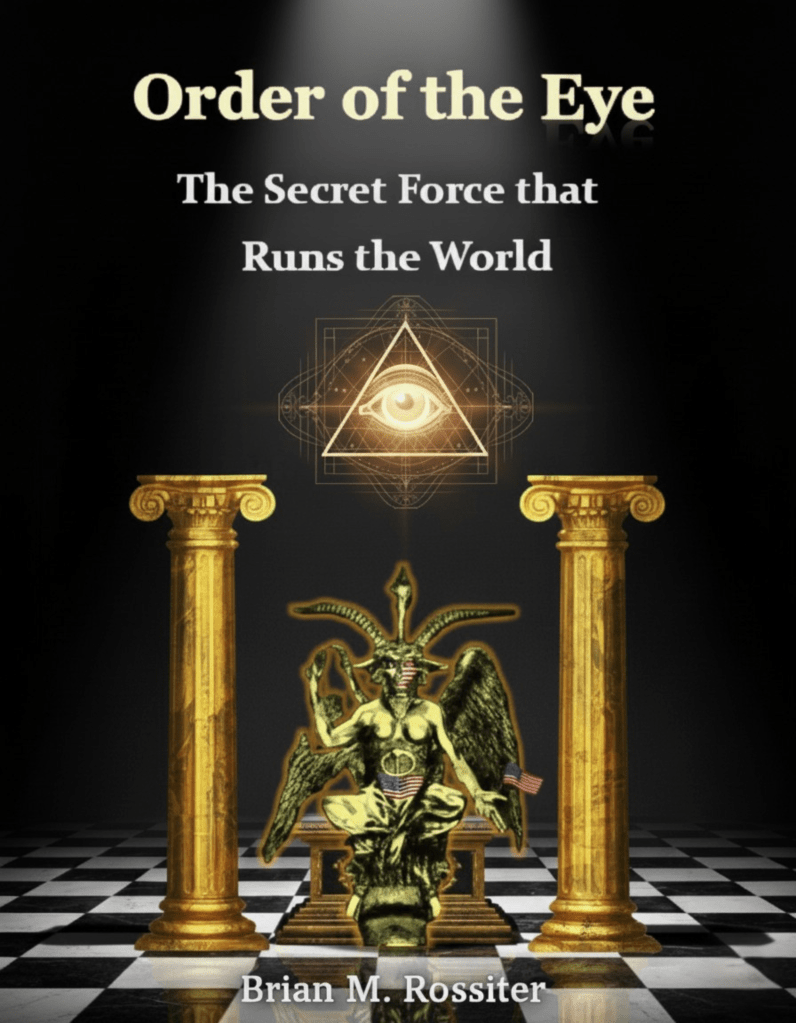
(To see the total picture at work in our world today, you must see my new book, Order of the Eye: The Secret Force that Runs the World.)
In last two articles, I described the beginning of the mystery surrounding Freemasonry and the deity that resides at the heart of the fraternity.
You will want to see those articles before proceeding, as they set the scene for this one. (Click here for the first article and here for the second)
Adapted directly from my latest book, Order of the Eye, this article will reveal precisely who the god of Freemasonry truly is. You will see why I call the secret force that runs the world the “Order of the Eye,” since nearly every esoteric and cultic group, as well as every false religion, all worship the same deity.
The one tie that binds them all is the Eye that they serve.
__________________
The All-Seeing Eye is ever-present within nearly all manifestations of the world’s “mystery religions.”
Most notably, the Eye’s prominence in Egyptian culture and religion comes to the forefront. There, it was most powerfully tied to the god Horus and was therefore called the “Eye of Horus,” or the Wedjat. Horus was believed to be the god of the sky, and of kingship and protection. In tradition, Horus lost his left eye in a violent battle with the god Seth (his uncle), who was broadly associated with chaos and destruction.[1]
In some accounts of the tale, Horus’ eye was restored to him by Thoth, the god of wisdom. Afterwards, it was believed to be imbued with magical properties that brought with it healing, restoration, and wholeness.[2] For this reason, it was (and still is) portrayed on amulets, other jewelry, and all manner of decorative items.
Over time and throughout the world’s cultures, the Eye took on both positive and negative connotations, particularly as other “eye traditions”—such as the evil Eye of Ra, which symbolized the sun god’s power—emerged and spread. The eye traditions still involved Horus, however, in myriad ways. Horus’ right eye was believed to represent the sun or the Morningstar.[3] This is a connection, then, to the many sun god traditions of other ancient religions and to another figure in the Bible that is called the “son of the morning” (i.e. Morningstar) in Isaiah 14:12.
This same concept can be seen in Hinduism, where the “third eye” of the god Shiva is seen as a bridge between the mortal and divine realms.[4] There are literally countless tales and beliefs throughout history about each of these figures and what the Eye is really supposed to mean.
In summation, the All-Seeing Eye became a tradition within nearly all (if not all) ancient religions and philosophies as something of a universal power and governing force over all humanity. It was seen as preserving the natural laws of the world and as the power that oversees human affairs.
The All-Seeing Eye is perhaps the central unifying symbol of the world’s mystery religions, cults, and esoteric philosophies. It is the one symbol that has transcended time and become applicable to people from all eras and cultures. This is perhaps truer today than ever. Whenever you see your favorite entertainers or celebrities—i.e. your favorites Freemasons—covering one eye, this is the force they are paying homage to. The next time you go shopping at your local cosmetic and fragrance stores, observe how frequently the people pictured within the various ads are covering or emphasizing one eye.
It should be no surprise, then, that the Freemasons and other prominent secret societies (like the Illuminati) have chosen to utilize the All-Seeing Eye within their traditions and practices. In fact, it shows up all throughout their writings and even within the U.S. capital itself.
This symbol is also sometimes called the “Eye of Providence,” particularly as it sits upon the top of the pyramid on the U.S. one-dollar bill (another Masonic creation). In this sense, the Eye watches over the nation and humanity at large. Much more about this connection will later be divulged when we evaluate the Masonic plan (i.e. the “Great Work”) in establishing a final empire and their placement of the Eye as its governing force.
For now, what can we conclude from all this? How do the Freemason’s understand the identity of the Eye and whom do they serve? At this point, I assume that the astute reader knows where all this is heading. We must, however, emphatically remove all doubts. In answering the previous questions, it is important to observe the words of the most revered and respected Masons in modern history. We first return to Manly P. Hall, as he revealed the true nature of their god in the clearest of ways. In speaking about the Fellow Craft degree, he wrote:
“When the Mason learns that the key to warrior on the block is the proper application of the dynamo of living power, he has learned the mystery of his craft. The seething energies of Lucifer are in his hands and before he may step onward and upward, he must prove his ability to properly apply energy.”[5]
It doesn’t get much clearer than this.
Earlier, I asked which “god” it is that the Mason seeks assistance from in keeping his oaths. Now, we can definitively answer this question. When we get to down to it, what is the terrifying truth—Freemasonry’s greatest “secret”—that has so strategically been hidden by layer upon layer of mystery and misdirection?
The bottom of the truth is this: the “god” of the Order—it’s All-Seeing Eye—is none other than Lucifer. That’s right: Satan is the lord of Freemasonry.
At this juncture, many readers will no doubt share a common response: this cannot be! Am I saying that the very fraternity that brought us the Shriners Hospital for Children, St. Jude Children’s Research Hospital, and innumerable other charitable foundations and events, secretly kneels before the Devil? Yes. Emphatically,yes.
While this will become literally undeniable by the end of the following chapters, it should already be apparent. Indeed, Lucifer— “the Devil,” “the great Serpent,” and the “father of lies”—is the one whom they serve. This is truly their big “secret,” and it’s a secret that is hidden in plain sight for all the world to not see.
Every Mason walking the earth—and the many people who belong to other related fraternities/sororities—kneels before Lucifer, though some may not even realize it. Before proving this grand assertion, something must be addressed. How could one even dare to associate Freemasonry—which is believed by many to be the most charitable organization on earth—with Satan, the one who Scripture calls the “god of this age” and the “ruler of this world”?[6] With the earlier knowledge about the “inner” and “outer” fraternities in place, we can further reveal this shocking reality. However, it bears repeating that Satan—Lucifer, the one that Masons call the “Light-bearer”—leads this brothel of demons.
Satan is the god of Freemasonry.
Not only is this evident throughout their rituals and practices, but it is directly spelled out within many other parts of their own literature. As you will see, there is no speculation required: no question about this reality whatsoever. It should be noted that, based on the oaths and rituals we have already evaluated, this has been proven.
If calling another man the “Worshipful Master,” swearing oaths under the penalty of death, being stripped down and blindfolded, having a noose attached to the neck (and other areas), believing that they are only now “entering the light,” and much more, does not reveal to you that the Masons are a dark Order who worships the Prince of Darkness, then you may well be living in delusion.
However, I will attempt to remove any remaining doubts by quoting more of their most respected members directly. Modern Freemasons—in attempting to distance themselves from such obviously malevolent claims—often deny the place of Manly P. Hall and others within their history. Even more often, they deny that the quotes mentioned here (and elsewhere) are authentic. Make no mistake about it: this is yet another lie that is used to conceal the truth about the Freemasons. As you will see in subsequent sections, when Nimrod is discussed, Masons secretly cherish the teachings of the “old guard” while externally denouncing them.
What else would we expect from a fraternity that conceals its truths and reveals its lies?
Albert Pike was a former Confederate States army general during the American Civil War. In fact, his monument proudly stood in Washington D.C from 1901 until 2020, when it was partially demolished by “peaceful protestors.”[7] Not surprisingly, President Donald J. Trump—himself a Freemason, though somewhat more covertly than certain others—promptly requested that Pike’s statue be erected once more.[8] This was not done, in my estimation, simply to protect “law and order” or preserve our history, but to revere a fellow Mason who shared Trump’s personal ideologies on many deep levels. Besides this, Pike was a well-known racist—at least throughout most of his life—and was an all-around curmudgeon, to put it very gently.
Some are aware of this but far fewer realize that Pike’s place in Freemasonry is the stuff of legend. He is immortal within the Order of the Eye. The Scottish Rite of Freemasonry—the Supreme Council for 33rd degree Masons—has given him the titles of Grand Archivist and Grand Historian of Freemasonry. Essentially, there is no higher authority within the Masons than Pike. Consider exactly how he described the “god” that his fraternity serves:
“Lucifer, the Light-bearer! Strange and mysterious name to give to the Spirit of Darkness! Lucifer, the Son of the Morning! It is he who bears the Light, and with its splendors intolerable blinds feeble, sensual, or selfish Souls! Doubt it not!”[9]
Can there be any questions about this? As Pike said: “Doubt it not!” Lucifer is the god of Freemasonry.
This sort of language is riddled throughout the writings of every renowned member of the Order. Often, they conceal their secrets with a bit more strategy. One such way is through the Masonic pentagram, or the Blazing Star. This can be seen when Albert Mackey—another distinguished and highly respected Masonic writer—discussed the meaning of the word “pentagram” in his Encyclopedia of Freemasonry.
There, he explains their secret view of what Lucifer represents. Mackey writes that the pentagram, depending on its orientation, represents the following things: good or evil, light or darkness, victory or death, initiation or profanation, and Lucifer or Vesper.[10] Do you notice what he did there? The italicized words are placed first in order, revealing Mackey’s true teaching and the belief held by the Masons at large: Lucifer represents goodness, light, victory, and true initiation into both the spiritual world and the Masonic fraternity.
Here, we have seen three of the most prolific Masons in modern history all say the same thing: Lucifer is lord. This reality, however, is not simply evident within the works of the “esoteric” Masons. In fact, such things are directly stated within the official publications designed for the “exoteric” Masons. That is, their common ritual books display this fact as well. In Duncan’s Masonic Ritual and Monitor, the All-Seeing Eye (of Lucifer) is specifically referenced as a part of the initiation into the Master Mason degree. The All-Seeing Eye is described as:
“(The one) whom the sun, moon, and stars obey, and under whose watchful care even comets perform their stupendous revolutions, beholds the inmost recesses of the human heart, and will reward us according to our works.”[11]
What does this description remind you of? Better said, who does it remind you of?
Scripture teaches that Jesus is the one who the sun, moon, and stars obey.[12] It is Jesus who judges the recesses of the human heart.[13] It is Jesus who specifically said that he will reward each person according to their works (Rev. 22:12). Do you understand what this means? Freemasonry has completely replaced Jesus for the All-Seeing Eye (of Lucifer) within their sacred scriptures and practices, and in the most specific ways imaginable. It is no surprise, then, that no recognized Masonic writing or ritual books specifically equate Jesus with God or call him Lord.
As we saw in the previous section through the works of Manly P. Hall, most Masons do not understand what lay at the heart of the fraternity. For the many Masons who comprise the “outer fraternity,” life under Satan’s wing is not what they believe they are working toward, nor do many ever reach the place where it is revealed to them.
Freemasonry’s system of degrees functions as a screening process. Those permitted to ascend—or to descend, really—to the highest degrees and participate in the “inner fraternity” have been heavily vetted. Only through this progression is one able to look past the façade and grasp the deepest secrets of the fraternity. Simply put, they embrace the “darkness made visible,” desiring to make Lucifer their god.
This is the secret that the Freemason’s hide (often in plain sight) from both the world and the Brothers that shield the Order’s ugly interior. In Masonic thought, Lucifer’s all-seeing gaze has been set upon the world for eons. He watches over our money, sitting atop the pyramid of the U.S. one-dollar bill. He is mirrored by our celebrities, politicians, and world leaders through their many signs and symbols.
The lord of the Masons is, quite simply, the one whom the Bible calls “the god of this world” (2 Cor. 4:4).
[1] See “History of the all-seeing eye.”
[2] Ibid.
[3] See “Horus: Egyptian God.”
[4] “History of the all-seeing eye.”
[5] Hall, The Lost Keys of Freemasonry, 48.
[6] See 2 Cor. 4:4 and John 14:30, where both Paul and Jesus make these claims.
[7] This occurred during one of the countless Black Lives Matter (BLM) violent riots, which were consistently called “peaceful protests” by the mainstream media.
[8] See “Trump Asks for Toppled D.C. Confederate Statue to Be Put Back Up.”
[9] Albert Pike, Morals and Dogma of the Ancient and Accepted Scottish Rite of Freemasonry, 321.
[10] Mackey, An Encyclopedia of Freemasonry, “Pentagram” (my emphasis).
[11] Duncan’s Ritual and Monitor of Freemasonry, “Master Mason, or Third Degree” (my emphasis).
[12] See Genesis 1:14-19, Psalms 8:3, and John 1:3 for a few examples.
[13] See 1 Samuel 16:7, Matthew 12:25, and Mark 2:8, for examples.