–
As I have chronicled for years, no one gets to the highest points of power and status within our world without being part of it.
And by “it,” I of course mean Freemasonry. The signs and symbols of those who run our world can be seen in every facet of human life. They are clearly visible within entertainment, sports, politics, and even children’s art.
In short, it is literally everywhere. (You simply must see the images on these links; you won’t believe your eyes.)
Most recently, I have described the entire Masonic system in more detail than ever within the book, Order of the Eye: The Secret Force that Runs the World. I firmly believe that it is the most thorough explanation of the fraternity, as well as how it fits with other satanic orders throughout world history, that you will ever read.
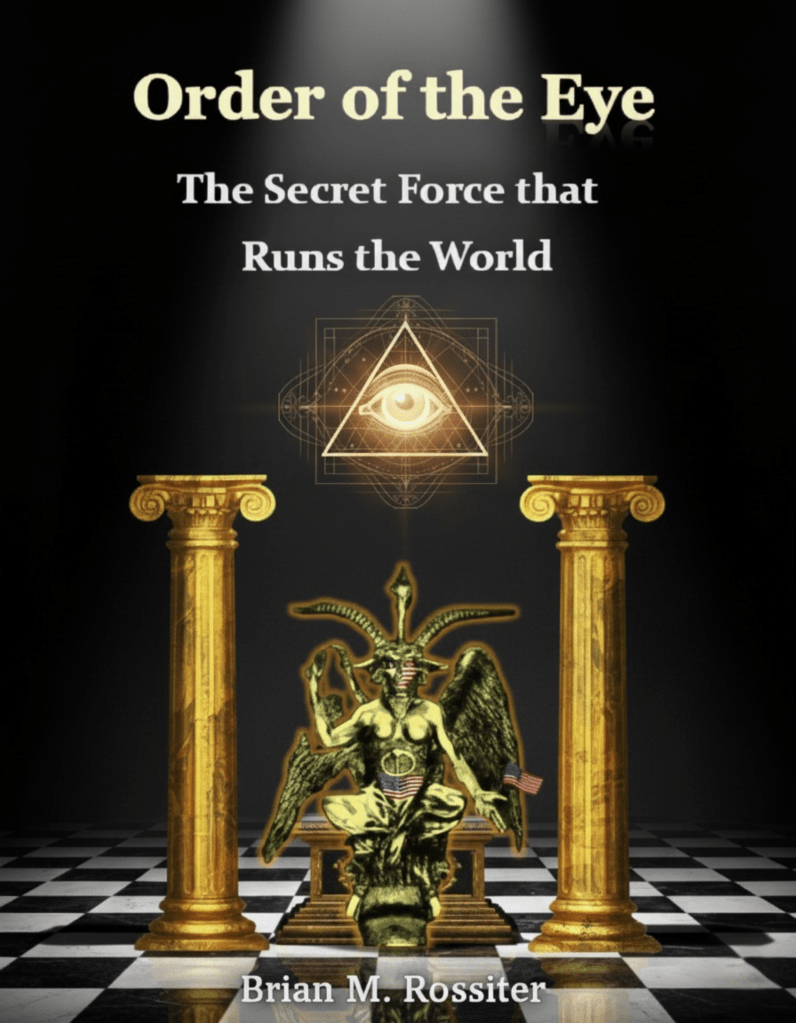
In this article, I have included the book’s introduction into the macabre world of those who control the comings and goings of the world. Hopefully, this will serve as catalyst for you to explore the many tendrils of the Masonic cult and all those associated with it.
(This article has been altered from the original book format).
Enjoy . . .
____________
To more fully explore the Masonic enterprise, let’s consider how it is presented to the world by its most distinguished writers. In 1946, Manly P. Hall—whom the Scottish Rite Journal (a supreme Masonic authority)—named the “Freemason of the 20th century,” wrote what is widely considered to be one of the seminal documents on Freemasonry. This text was called The Lost Keys of Freemasonry.
In it, he describes both the revealed and concealed world of the Masons in truly covert fashion. Within the often-veiled language is something of a “higher level” knowledge that is intended for those within the society but is concealed beneath a Masonic message to the masses. In a sense, the book reads like a long parable; those with Masonic “eyes to see” will grasp its true meaning, while most of the world—the “blind” peasantry—will be unable to pierce through the veil to discover Freemasonry’s true purposes. As you will see, the latter group contains the majority of those who call themselves members of the Fraternity.
The Lost Keys of Freemasonry, then, is a perfect microcosm of how the Order operates and covertly spreads its teachings to the world.
First, it simply must be understood that Freemasonry is not merely a social club or fellowship organization. While this is how its ordinary members will typically describe it, Hall reveals that the true Mason understands that the Fraternity is anything but that:
“The Masonic order is not a mere social organization, but is composed of all those who have banded themselves together to learn and apply the principles of mysticism and occult rites.”[1]
You read that correctly—mysticism and occult rites. We will return to this line of thinking but, for now, understand that Masonry is not a “good old boys club” or “a mere social organization.” Far from it.
On the surface, Freemasonry is passed off to the “unseeing world” as a collection of astute thinkers who together comprise a greater institute of learning and opportunity. This gets to Hall’s “Order of the Quest,” which will be explained when the Masonic purposes for America are later evaluated. Hall explains this institute of learning and opportunity as follows:
“Masonry is a university, teaching the arts and sciences of the soul to all who will attend its words.”[2]
Masonry, then, is a global “university” without walls; it is the most distinguished of intellectual academies whose chief purpose is to arouse in its students the capacity for human greatness. Hall explains its purposes as follows: “These higher ideals, these spiritual concepts, these altruistic, philanthropic, educative applications of thought power glorify the Builder.”[3] Who could argue with such intentions? Wouldn’t any thinking man or woman long to see a world where the masses operated on such principles, and to the glory of the “Builder?”
The unparalleled academic pursuit of Freemasonry, however, is not to be outshined by its spiritual purposes. Not only is Freemasonry seen as a mystical and intellectual enterprise, but it is also steeped in biblical language and godly idealism. Hall remarks that:
“True Freemasonry is esoteric; it is not a thing of this world. All that we have here is a link, a doorway, through which the student may pass into the unknown.”[4]
To be sure, this “esoteric” design—meaning that it pertains only to an initiated (and small) number of members—is thoroughly spiritual in nature:
“(The Mason) must realize that the ancient mystic teachings as perpetuated in the modern rites are sacred, and that powers unseen and unrecognized mold the destiny of those who consciously and of their own free will take upon themselves the obligations of the Fraternity.”[5]
Not only is Masonry both spiritual and religious in nature, but it is specifically of the biblical variety. All throughout Hall’s work are sentiments about God, the King of the Universe, the Chief/Master Architect, the Holy Sepulcher, and the talk of holiness, virtue, light, and innumerable like terms.
Speaking of the Master Mason—that is, the Mason who has mastered the Craft:
“The Word is found when the Master himself is ordained by the living hand of God, cleansed by the living water, baptized by living fire, a Priest-King after the Order of Melchizedek, who is above the law.”[6]
There are two things of note in this statement. The first is the biblical language and motifs being employed to describe the Order. Being “cleansed by water” is a clear allusion to baptism, and being “baptized by living fire” is precisely how Scripture describes the believer’s initiation into Christ: “I baptize you with water for repentance, but he who is coming after me is mightier than I, whose sandals I am not worthy to carry. He will baptize you with the Holy Spirit and fire.”[7]
The second thing worth noticing is strongly connected to these concepts, specifically the person of Jesus. Note that the Master Mason is made into “a Priest-King after the Order of Melchizedek.” In Christian thought, the only individual who fits this role is Jesus himself: “For it is witnessed of him, ‘You are a priest forever, after the order of Melchizedek” (Heb. 7:17). According to Hall—and, thus, in true Masonic thought—the Master Mason essentially becomes divine, as both he and Jesus are “after the order of Melchizedek.”
Such a notion will be specifically exemplified in later sections when George Washington and the symbolism present within Washington D.C. are discussed. Trust that, in the Order, it is no foreign concept for a man to attain to divine status. For now, what must be apparent is that Freemasonry is richly described in religious terms. For the casual reader, the way Hall (and others) describe their beloved fraternity would no doubt pass as devout and even holy in nature. That, to be sure, is very much the objective.
As one works through the vast ocean of Masonic literature available, it becomes clear that Freemasonry—like all other parts of the ancient traditions broadly called the “Mystery Religions”—is genuinely diverse in its approach to “the Divine.” That is, the tradition recognizes a plurality of gods and is, thus, polytheistic. As you will later see, there is of course one deity that stands above the rest and, in a sense, is the perfect manifestation of this plurality. Nonetheless, many deities are recognized and are paid either homage or mention within their literature. Hall recognizes this reality in many places, with one such example being here, where he is describing the inward disposition of the Mason:
“But all these expressions of the human heart must become transmuted into the emotionless compassion of the gods, who despite the suffering of the moment gaze down upon mankind and see that it is good.”[8]
Not only does this speak to their belief in many gods, but it also shows one of the innumerable places where its precepts are in complete opposition to orthodox biblical teachings. The Bible describes one God, not many. It also teaches plainly that man is fallen and, thus, is sinful by nature. Man in his current form is not “good,” but is only made good through the redemptive work of Jesus.
Lastly, this seems to hearken back to the events of the Tower of Babel, wherein God saw the wickedness of the human heart and flooded the earth. In the Masonic tradition, Babel did not mark the failure of man but spoke to his goodness. This will be discussed in detail shortly.
Despite its seeming adherence to biblical teachings, one finds that the Masonic system usurps Scripture in all manner of ways, both subtle and overt. Hall displays this here again in one of the smaller, but still significant ways:
“No true Mason can be narrow, for his Lodge is the divine expression of all broadness.”[9]
This speaks to both the religious and moral disposition of the Mason. Just as a broadness of deities are observed, so too is a broadness of morality. Aleister Crowley—who was, despite much talk to the contrary, quite clearly a prominent Satanist—spoke directly to this matter. Crowley, the man who founded Thelema—an esoteric and occult spiritual philosophy and religious movement—and called himself “the Beast 666,” coined what is perhaps the operating moral standard for the overall collection of all mystics, occultists, and yes, Freemasons.
In his seminal text, The Book of the Law,[10] Crowley created an axiom that would later echo within Masonic lodges and the meeting places of all manner of secret societies for countless years to come: “Do what thou wilt shall be the whole of the Law.” While this phrase alone has been the subject of much discussion and explanation, its core meaning cannot be missed—discovering and following one’s “True Will” is the path to self-realization and personal fulfillment. In Masonic thought, this often manifests in what is called—on an individual level—the “Great Work.”
In short, there is nothing that is off limits within this pursuit; there are no real moral and ethical restrictions. In this sense, nature is itself a god.
Not surprisingly, Thelema’s most recognizable symbol is a unicursal hexagram. The unicursal hexagram is a twist on none other than the Masonic Square and Compasses, which is the most recognizable symbol in Freemasonry. In fact, it is the very symbol that marks the local lodge and is present on almost everything having to do with the fraternity. Look closely, because you are bound to see one in a town near you.
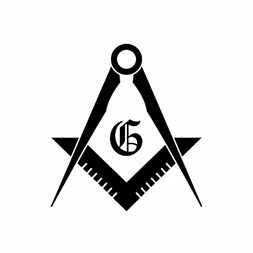
This symbol consists of three main elements: the square, the compasses, and the letter “G.”[11] The square (builders square) is alleged to allow the craftsmen to create perfect square corners. Symbolically, it is said to remind the Mason of his duty to be honest and fair (i.e. “square”) in his dealings with others, especially fellow Masons. The compasses are critical in geometry for drawing perfect circles and arcs, something necessary for a craftsman.
For the Mason, it symbolizes the need for self-restraint and man’s ability to reign in his yearnings so that he may live a balanced life. Finally, the “G” is seen as standing for different concepts. One notion is that it stands for “geometry,” and another that it refers to God or the “Great Architect of the Universe.”
While these would be the outer or “exoteric” meanings passed on to the average Mason, the truth is of course somewhat deeper. Notice how the Square and Compasses are arranged with one another. In theory, these could be placed in any number of ways, yet the compasses are placed above and intersecting with the square. Look closely: does this suggest anything to you? If you think it looks a bit like a male “mounting” a female, then your eyes are not deceiving you. And what of the “G?” Well, it represents “generation,” as in the generation of energy from the union of the male and female parts.
In other words, the symbol that officially marks the Freemasons is a sex act. Don’t believe me? For one thing, this explains precisely why the Masonic apron (discussed later) is worn below the waste, covering the genitals. Secondly, Albert Mackey—one of the most authoritative writers in Masonic history—has explained this reality for us. In speaking about the hexagram structure of “Star of David,” which is discussed again later and strongly resembles the geometry of the Square and Compasses, Mackey explained the following:
“The triangle pointing downward is a female symbol corresponding to the yoni and the upward pointing triangle is the male, the lingam. When the two triangles are interlaced, it represents the union of the active and passive forces in nature; it represents the male and female elements.”[12]
Yes, the symbol of the modern Jewish nation is connected to the Masonic Square and Compasses, and both illustrate the sexual union of the male and female parts. Is this getting a little strange for you yet?
Returning to Crowley, Thelema’s official symbol contains a modified Square and Compasses, and for good reason. Not only did Crowley identity himself as “the Beast 666,” which is a clear allusion to Revelation’s Antichrist figure, but he was also a “very irregular” Freemason.[13] Though he quickly rose through the 33 degrees of Freemasonry in a “miniscule irregular body” in Mexico City, his path only began at that point. Crowley went on to serve as the National Grand Master of the Ordo Templi Orientis, which is often characterized as something of an occult secret society and hermetic magical organization.[14]
Though he was a 33rd degree Mason and Grand Master, his own “path” was viewed by some as being overly esoteric and “fringe” when compared to other bodies of the Order. As such, he was a Mason through his association with certain “clandestine” appendages of the fraternity but was not recognized by its greatest governing body in Europe, the United Grand Lodge of England.
In essence, this means that his practice was thought to be done secretly and was not representative of the larger Order. Crowley expressed both his discontent and the hypocrisy of the situation in some of his writings. Concerning the label of being “clandestine,” he said that the term:
“. . . (is) applied by any Mason to any other Mason with whom he is not officially allied; though the “Secrets,” Rituals, etc., may be identical. It is a question of jurisdiction; a sectarian squabble the rights and wrongs of which probably never existed, and are in any case lost in antiquity and confusion.”[15]
This is a critical observation. In this, we see that Freemasonry is not only veiled through its “inner” and “outer” fraternities but is also cloaked by its unparalleled access to what is called “plausible deniability.” One popular dictionary defines this term as follows: “the ability to say in a way that seems possibly true that you did not know about something or were not responsible for something.”[16] Put in this context, the Mason can distance himself from certain people or practices while utterly refusing to condemn or reject them.
Remember, however, Hall’s revelation that the “Lodge is the divine expression of all broadness.” In this, we see that Freemasonry has been ingeniously engineered and is concealed within layers upon layers of mystery, secrecy, truth, and lies. The Masonic system is so veiled, in fact, that its “broadness” effectively runs cover for the many practices (and people) one finds within it. When a Mason develops a reputation for crude acts or is open about their involvement in Satanism or the dark arts, then plausible deniability can always be used as a defense.
A Mason (or group of Masons) can claim that, even though one member or Masonic group is involved with a particular practice, it does not mean that they are. It also wouldn’t “speak for Freemasonry” as a whole. This is how the everyday Mason can indirectly support the darkest parts of the Order while also believing that they live apart from them; “My” Masonry isn’t “their” Masonry, though we are all “Brothers.” Such a system could only be the product of demonic inspiration from the top down.
With this said, it can be plainly seen just how “broad” Freemasonry is. The true Mason must be polytheistic, pluralistic, pantheistic, and virtually every other “istic” term imaginable. What he decidedly is not, however, is monotheistic. That would be far too “narrow.” This, of course, is utterly antithetical to the message of Jesus. He taught that salvation and, thus, true spiritual “enlightenment” comes by entering through the narrow gate:
“Enter by the narrow gate. For the gate is wide and the way is easy that leads to destruction, and those who enter by it are many. For the gate is narrow and the way is hard that leads to life, and those who find it are few” (Mt. 7:13-14).
Conversely, the wide (or “broad”) gate—the course of the Mason and the “many”—is precisely the gate that leads to everlasting destruction. One may “do what they wilt” on the broad path, but they cannot keep their soul in the process of walking it.
Understand that we have barely begun to see what lies at the heart of the Order and, still, certain key truths have emerged. Freemasonry conceals itself within Christian trappings though it admits to being thoroughly “broad” in its approach to religion, philosophy, and morality. This will become irrefutable as we progress. While claiming the ideas set forth within Scripture, it covertly subverts them. While claiming to create the enlightened philosophers and men of virtue, it creates dulled simpletons who either directly or indirectly support the vilest practices under the heavens. While it claims to lead its followers to the light, it guides them through a slow descent into the darkness.
Even at this early stage of the chapter, however, you may be questioning all this. Even if what I am saying is true, and the Masonic system is a bit “strange,” is it really the system that controls the affairs of the world? It just doesn’t seem possible, does it? After all, most of us know a Mason or two, and they’re “nothing like” this! Some will say: “My father and uncle are Masons, and they are kind and generous men.” Others may have a friend or spouse who is a part of the Masons or OES (The Order of the Eastern Star) and think the same about them.
The Masons host pancake breakfasts and create college scholarships, right? They were instrumental in establishing children’s hospitals like the Shriner’s Hospitals for Children and St. Jude’s, after all. As mentioned earlier, every Shriner is required to first become a Master Mason. Hopefully, you have not so quickly forgotten what steps are required to reach this degree. The necessity of being a Freemason is directly stated on the Shiners International website in black and white:
“To become a Shriner, a man must first become a Master Mason. If you are not yet a Mason, take the first step to becoming a Shriner. You will be working closely with individuals from the lodge as you move forward on the path to becoming a Shriner.”[17]
As for St. Jude’s, its founder—Danny Thomas—boasted of being a (33rd degree) Mason:
“I was a Freemason in my heart long before I was accepted as a member in this great Fraternity. I was an outsider but now I am one of you, and the remaining years of my life will be spent in seeking in some small way to say to all: ‘Thank you for making me a Freemason’.”[18]
That settles it: the Masons are a grand and benevolent fraternity. They are doers of good, men of the light, and the moral champions of our communities.
This may look and sound accurate, but things are not always what they appear to be. In fact—and as we saw with the narcissistic enterprise that now runs rampant throughout the world—things are seldom what they appear to be. The incredible reality is that Freemasonry is a religious order—it is, in fact, fundamentally religious in nature—and is comprised of two distinct but unified groups.
On the surface, there are those who have not reached the highest ranks, who function much like a gentleman’s club. This group is the visible form of Freemasonry that is displayed to the masses; these are the men and women holding public events, hosting charity functions, and running booths at local festivals. Put another way, this sector functions as the everyday foot soldiers who display the wonders of “the Craft” to the world. They are the very reason why the Masons are often held in such high esteem. Incredibly, many of these foot soldiers don’t have the faintest idea of what resides at the center of their beloved fraternity. This is critical to remember.
Is there an explanation for how such a thing could be possible: that is, how the Masons can appear as kind and virtuous people while secretly serving quite another purpose? Well, this gets back to the fact that Freemasonry is a multi-layered enterprise. Once again, Hall explains this, saying:
“Freemasonry is a fraternity within a fraternity—an outer organization concealing an inner brotherhood of the elect. Before it is possible to intelligently discuss the order of the Craft it is necessary to establish the existence of these two separate yet independent orders, the one visible and the other invisible. The visible society is a splendid camaraderie of ‘free and accepted’ men enjoined to devote themselves to ethical, educational, fraternal, patriotic, and humanitarian concerns. The invisible society is a secret and most august fraternity whose members are dedicated to the service of a mysterious arcanum arcanorum.”[19]
We will return to the phrase “arcanum arcanorum” momentarily, but let’s stay with the main point at hand.
Here, Hall revealed one of the deepest mysteries of Freemasonry: the Masonic enterprise is not one fraternity but two. As Hall put it, there is a “fraternity within a fraternity.” Elsewhere, this is very specifically established. Speaking of those who might seek advancement solely for personal gain, Hall wrote:
“They can never do harm to Freemasonry because they cannot get in. Ensconced within the lodge, they may feel that they have deceived the Grand Master of the Universe, but when the spiritual lodge meets to carry on the true work of the Craft, they are disqualified and absent.”[20]
The word “ensconced” means “hidden” or “concealed.” Since Freemasonry is a veiled system that is utterly esoteric (for the few) and speculative (unseen and philosophical) in nature, its real identity is hidden from all but its chosen members. Hence, only the true Mason is part of the spiritual lodge and can be entrusted to participate in the true work of the Craft. If this were not clear enough, Hall describes precisely how this divide plays out in reality:
“There are thousands of Masons who are brethren in name only, for their failure to exemplify the ideals of their Craft makes them unresponsive to the teachings and purpose of Freemasonry.”[21]
This is so important to understand that it could bear repeating several times over. I trust, however, that once will be enough. In simplest terms, this means that most Masons are gleefully participating in an outer fraternity, or the candy-coated shell that hides the hideous interior. Those within this group function as the foot soldiers that project the concepts of brotherhood and goodness to the world; they are a “splendid camaraderie of ‘free and accepted’ men.”
This is why many Masons dismiss the words of fellow fraternity members like Hall, Pike, Mackey, and others who are historically considered to be some of the most influential figures in modern Freemasonry. They will talk about how these Masons ventured out on their own, choosing to take a wildly “esoteric” path. Such claims are made by those who would call themselves “exoteric” Masons, meaning that they are following the outward expression of the fraternity. They have concerned themselves with the degrees, general teachings, and viewable expressions of Freemasonry.
Put another way, they are part of the “visible society” and are so blinded by its Jewish and Christian trappings that they never see into the darkness of the “invisible society.” As such, they serve as good little servants, defending the Order and calling everyone else—often even fellow Masons of the esoteric and invisible society—“kooks” or “rogue Masons.” There is little doubt that such members will also leave poor reviews of this book and attempt to disparage its message. In essence, the true purpose of Freemasonry is concealed by those who, of their own ignorance, run cover for it.
As previously noted, all this likely explains how one’s Masonic friends and family are viewed as benevolent and why Freemasonry maintains its esteemed (but mysterious) position in the thoughts and minds of most individuals. Members of this “outer fraternity”—despite taking upon themselves the gruesome oaths previously mentioned—often fail to see whom they are really serving. In truth, these individuals may be upstanding citizens (of this world, at least). They likely don’t understand that they are concealing the inner sanctum of their fraternity with the garments of their good deeds.
I, too, know people of this ilk.
The invisible society, as Hall plainly says, is the “secret and most august fraternity.” This fraternity is the true religion that resides at the heart of the Masonic enterprise. Only when one advances to the highest “degrees” that extend far beyond the Blue Lodge does the Mason arrive at the true workings of the Craft, and only then is he invited to participate in the genuine religion of the Fraternity.
This is the religion whose members are dedicated to the service of a mysterious arcanum arcanorum; that is, the “mystery of mysteries.” Merriam-Webster defines this as “the one ultimate secret supposed to lie behind all astrology, alchemy, and magic.”[22]
Magic?
Why would magic have anything to do with such a benevolent fraternity like the Freemasons? This question speaks directly to the fabric of the greatest secret hidden within the Order.
To continue the search, see Order of the Eye for yourself.
[1] Hall, The Lost Keys of Freemasonry, 19 (my emphasis).
[2] Ibid, xxi.
[3] Ibid, 30.
[4] Ibid. 16
[5] Ibid. 11; I added “(The Mason)” for clarity.
[6] Ibid. 59
[7] See Matthew 3:11, my emphasis.
[8] Hall, The Lost Keys of Freemasonry, 50.
[9] Ibid. 65
[10] Crowley, The Book of the Law, (1904)
[11] The following points are taken from the Grand Lodge of Ohio’s, “Behind the Masonic Symbols: Square and Compasses.”
[12] Mackey, The Symbolism of Freemasonry, 195.
[13] See Wade’s, “Aleister Crowley – a very irregular Freemason.”
[14] See, “Aleister Crowley’s Journey from Freemasonry to the O.T.O.”
[15] Ibid.
[16] Cambridge Dictionary, “Plausible Deniability.”
[17] Shriners International, “Define your path.”
[18] Thomas, “It is great to be a Freemason.”
[19] Manly P. Hall, Lectures on Ancient Philosophy, 433.
[20] Hall, The Lost Keys of Freemasonry, 43 (my emphasis).
[21] Ibid. 72.
[22] Merriam-Webster, “arcanum arcanorum.”


2 thoughts on “Freemasonry: A Veiled System”