Freemasonry: A Veiled System

As I have chronicled for years, no one gets to the highest points of power and status within our world without being part of it.

And by “it,” I of course mean Freemasonry. The signs and symbols of those who run our world can be seen in every facet of human life. They are clearly visible within entertainment, sports, politics, and even children’s art.

In short, it is literally everywhere. (You simply must see the images on these links; you won’t believe your eyes.)

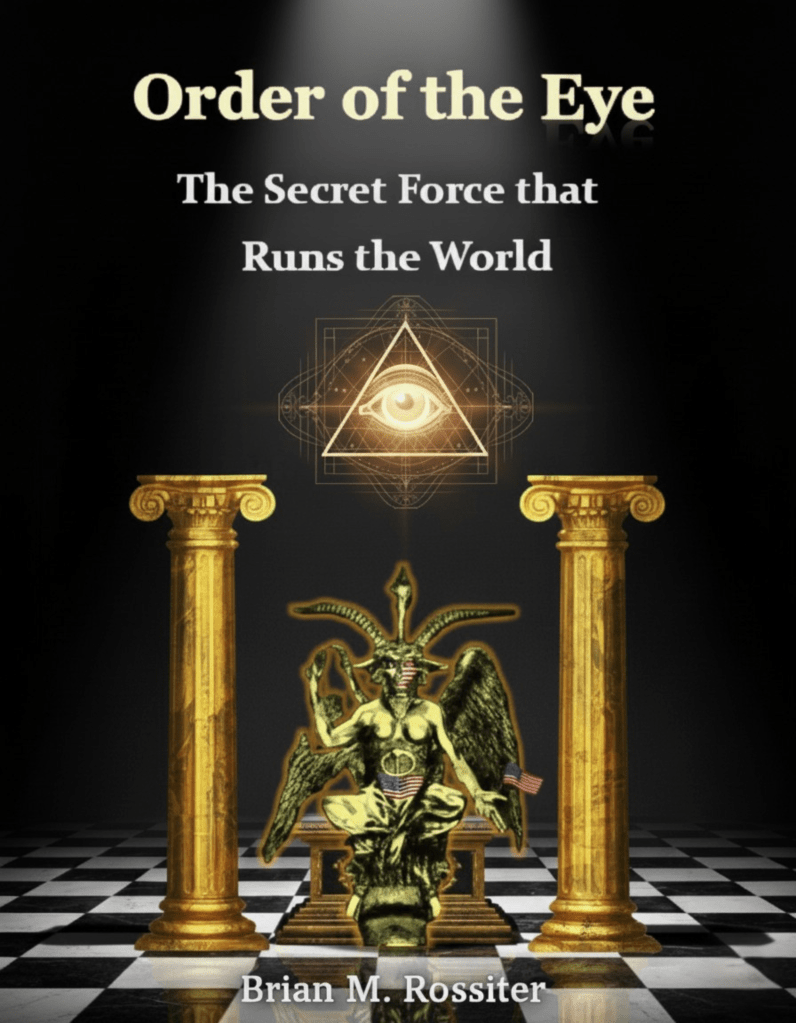
Most recently, I have described the entire Masonic system in more detail than ever within the book, Order of the Eye: The Secret Force that Runs the World. I firmly believe that it is the most thorough explanation of the fraternity, as well as how it fits with other satanic orders throughout world history, that you will ever read.

In this article, I have included the book’s introduction into the macabre world of those who control the comings and goings of the world. Hopefully, this will serve as catalyst for you to explore the many tendrils of the Masonic cult and all those associated with it.

(This article has been altered from the original book format).

Enjoy . . .

____________

To more fully explore the Masonic enterprise, let’s consider how it is presented to the world by its most distinguished writers. In 1946, Manly P. Hall—whom the Scottish Rite Journal (a supreme Masonic authority)—named the “Freemason of the 20th century,” wrote what is widely considered to be one of the seminal documents on Freemasonry. This text was called The Lost Keys of Freemasonry.

In it, he describes both the revealed and concealed world of the Masons in truly covert fashion. Within the often-veiled language is something of a “higher level” knowledge that is intended for those within the society but is concealed beneath a Masonic message to the masses. In a sense, the book reads like a long parable; those with Masonic “eyes to see” will grasp its true meaning, while most of the world—the “blind” peasantry—will be unable to pierce through the veil to discover Freemasonry’s true purposes. As you will see, the latter group contains the majority of those who call themselves members of the Fraternity.

The Lost Keys of Freemasonry, then, is a perfect microcosm of how the Order operates and covertly spreads its teachings to the world.

First, it simply must be understood that Freemasonry is not merely a social club or fellowship organization. While this is how its ordinary members will typically describe it, Hall reveals that the true Mason understands that the Fraternity is anything but that:

You read that correctly—mysticism and occult rites. We will return to this line of thinking but, for now, understand that Masonry is not a “good old boys club” or “a mere social organization.” Far from it.

On the surface, Freemasonry is passed off to the “unseeing world” as a collection of astute thinkers who together comprise a greater institute of learning and opportunity. This gets to Hall’s “Order of the Quest,” which will be explained when the Masonic purposes for America are later evaluated.  Hall explains this institute of learning and opportunity as follows:

Masonry, then, is a global “university” without walls; it is the most distinguished of intellectual academies whose chief purpose is to arouse in its students the capacity for human greatness. Hall explains its purposes as follows: “These higher ideals, these spiritual concepts, these altruistic, philanthropic, educative applications of thought power glorify the Builder.”[3] Who could argue with such intentions? Wouldn’t any thinking man or woman long to see a world where the masses operated on such principles, and to the glory of the “Builder?”

The unparalleled academic pursuit of Freemasonry, however, is not to be outshined by its spiritual purposes. Not only is Freemasonry seen as a mystical and intellectual enterprise, but it is also steeped in biblical language and godly idealism. Hall remarks that:

To be sure, this “esoteric” design—meaning that it pertains only to an initiated (and small) number of members—is thoroughly spiritual in nature:

Not only is Masonry both spiritual and religious in nature, but it is specifically of the biblical variety. All throughout Hall’s work are sentiments about God, the King of the Universe, the Chief/Master Architect, the Holy Sepulcher, and the talk of holiness, virtue, light, and innumerable like terms.

Speaking of the Master Mason—that is, the Mason who has mastered the Craft:

There are two things of note in this statement. The first is the biblical language and motifs being employed to describe the Order. Being “cleansed by water” is a clear allusion to baptism, and being “baptized by living fire” is precisely how Scripture describes the believer’s initiation into Christ: “I baptize you with water for repentance, but he who is coming after me is mightier than I, whose sandals I am not worthy to carry. He will baptize you with the Holy Spirit and fire.”[7]

The second thing worth noticing is strongly connected to these concepts, specifically the person of Jesus. Note that the Master Mason is made into “a Priest-King after the Order of Melchizedek.” In Christian thought, the only individual who fits this role is Jesus himself: “For it is witnessed of him, ‘You are a priest forever, after the order of Melchizedek” (Heb. 7:17). According to Hall—and, thus, in true Masonic thought—the Master Mason essentially becomes divine, as both he and Jesus are “after the order of Melchizedek.”

Such a notion will be specifically exemplified in later sections when George Washington and the symbolism present within Washington D.C. are discussed. Trust that, in the Order, it is no foreign concept for a man to attain to divine status. For now, what must be apparent is that Freemasonry is richly described in religious terms. For the casual reader, the way Hall (and others) describe their beloved fraternity would no doubt pass as devout and even holy in nature. That, to be sure, is very much the objective.

As one works through the vast ocean of Masonic literature available, it becomes clear that Freemasonry—like all other parts of the ancient traditions broadly called the “Mystery Religions”—is genuinely diverse in its approach to “the Divine.” That is, the tradition recognizes a plurality of gods and is, thus, polytheistic. As you will later see, there is of course one deity that stands above the rest and, in a sense, is the perfect manifestation of this plurality. Nonetheless, many deities are recognized and are paid either homage or mention within their literature. Hall recognizes this reality in many places, with one such example being here, where he is describing the inward disposition of the Mason:

Not only does this speak to their belief in many gods, but it also shows one of the innumerable places where its precepts are in complete opposition to orthodox biblical teachings. The Bible describes one God, not many. It also teaches plainly that man is fallen and, thus, is sinful by nature. Man in his current form is not “good,” but is only made good through the redemptive work of Jesus.

Lastly, this seems to hearken back to the events of the Tower of Babel, wherein God saw the wickedness of the human heart and flooded the earth. In the Masonic tradition, Babel did not mark the failure of man but spoke to his goodness. This will be discussed in detail shortly.

Despite its seeming adherence to biblical teachings, one finds that the Masonic system usurps Scripture in all manner of ways, both subtle and overt. Hall displays this here again in one of the smaller, but still significant ways:

This speaks to both the religious and moral disposition of the Mason. Just as a broadness of deities are observed, so too is a broadness of morality. Aleister Crowley—who was, despite much talk to the contrary, quite clearly a prominent Satanist—spoke directly to this matter. Crowley, the man who founded Thelema—an esoteric and occult spiritual philosophy and religious movement—and called himself “the Beast 666,” coined what is perhaps the operating moral standard for the overall collection of all mystics, occultists, and yes, Freemasons.

In his seminal text, The Book of the Law,[10] Crowley created an axiom that would later echo within Masonic lodges and the meeting places of all manner of secret societies for countless years to come: “Do what thou wilt shall be the whole of the Law.” While this phrase alone has been the subject of much discussion and explanation, its core meaning cannot be missed—discovering and following one’s “True Will” is the path to self-realization and personal fulfillment. In Masonic thought, this often manifests in what is called—on an individual level—the “Great Work.”

In short, there is nothing that is off limits within this pursuit; there are no real moral and ethical restrictions. In this sense, nature is itself a god.

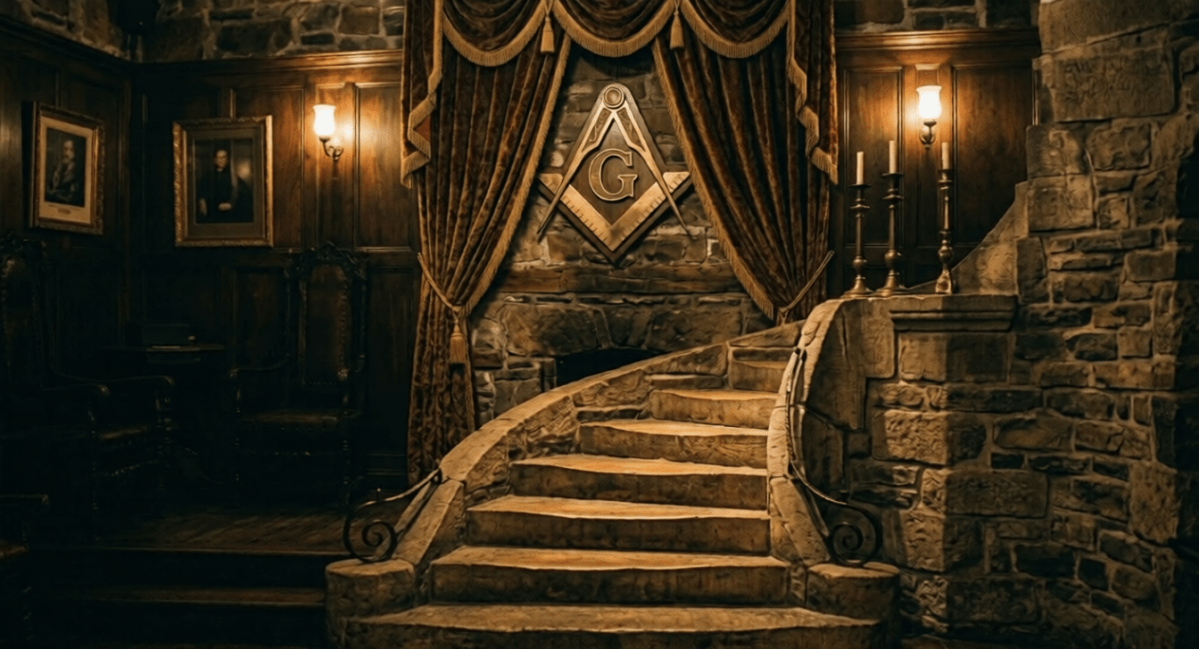
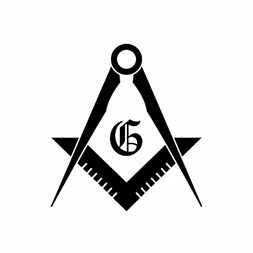
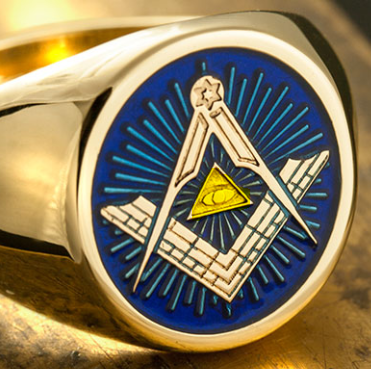
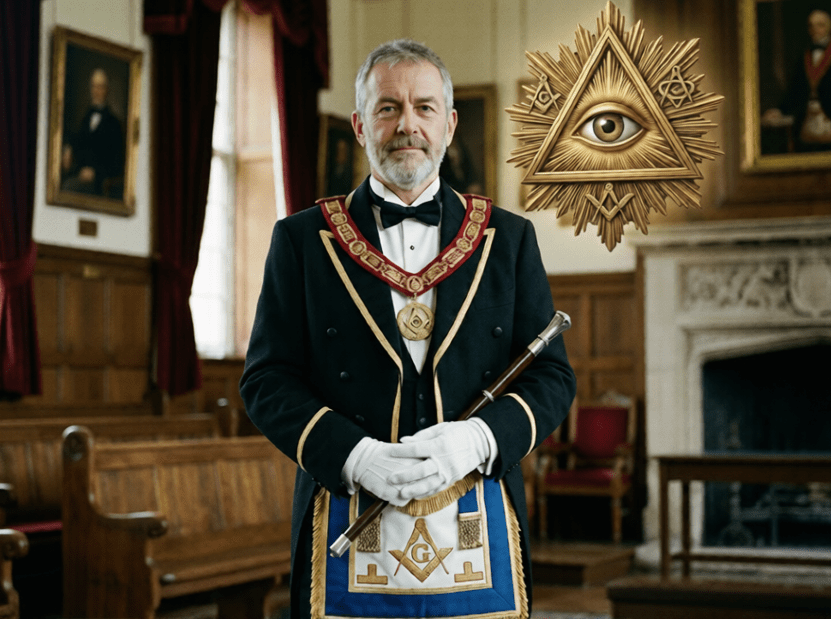
Not surprisingly, Thelema’s most recognizable symbol is a unicursal hexagram. The unicursal hexagram is a twist on none other than the Masonic Square and Compasses, which is the most recognizable symbol in Freemasonry. In fact, it is the very symbol that marks the local lodge and is present on almost everything having to do with the fraternity. Look closely, because you are bound to see one in a town near you.

This symbol consists of three main elements: the square, the compasses, and the letter “G.”[11] The square (builders square) is alleged to allow the craftsmen to create perfect square corners. Symbolically, it is said to remind the Mason of his duty to be honest and fair (i.e. “square”) in his dealings with others, especially fellow Masons. The compasses are critical in geometry for drawing perfect circles and arcs, something necessary for a craftsman.

For the Mason, it symbolizes the need for self-restraint and man’s ability to reign in his yearnings so that he may live a balanced life. Finally, the “G” is seen as standing for different concepts. One notion is that it stands for “geometry,” and another that it refers to God or the “Great Architect of the Universe.”

While these would be the outer or “exoteric” meanings passed on to the average Mason, the truth is of course somewhat deeper. Notice how the Square and Compasses are arranged with one another. In theory, these could be placed in any number of ways, yet the compasses are placed above and intersecting with the square. Look closely: does this suggest anything to you? If you think it looks a bit like a male “mounting” a female, then your eyes are not deceiving you. And what of the “G?” Well, it represents “generation,” as in the generation of energy from the union of the male and female parts.

In other words, the symbol that officially marks the Freemasons is a sex act. Don’t believe me? For one thing, this explains precisely why the Masonic apron (discussed later) is worn below the waste, covering the genitals. Secondly, Albert Mackey—one of the most authoritative writers in Masonic history—has explained this reality for us. In speaking about the hexagram structure of “Star of David,” which is discussed again later and strongly resembles the geometry of the Square and Compasses, Mackey explained the following:

Yes, the symbol of the modern Jewish nation is connected to the Masonic Square and Compasses, and both illustrate the sexual union of the male and female parts. Is this getting a little strange for you yet?

Returning to Crowley, Thelema’s official symbol contains a modified Square and Compasses, and for good reason. Not only did Crowley identity himself as “the Beast 666,” which is a clear allusion to Revelation’s Antichrist figure, but he was also a “very irregular” Freemason.[13] Though he quickly rose through the 33 degrees of Freemasonry in a “miniscule irregular body” in Mexico City, his path only began at that point. Crowley went on to serve as the National Grand Master of the Ordo Templi Orientis, which is often characterized as something of an occult secret society and hermetic magical organization.[14]

Though he was a 33rd degree Mason and Grand Master, his own “path” was viewed by some as being overly esoteric and “fringe” when compared to other bodies of the Order. As such, he was a Mason through his association with certain “clandestine” appendages of the fraternity but was not recognized by its greatest governing body in Europe, the United Grand Lodge of England.

In essence, this means that his practice was thought to be done secretly and was not representative of the larger Order. Crowley expressed both his discontent and the hypocrisy of the situation in some of his writings. Concerning the label of being “clandestine,” he said that the term:

This is a critical observation. In this, we see that Freemasonry is not only veiled through its “inner” and “outer” fraternities but is also cloaked by its unparalleled access to what is called “plausible deniability.” One popular dictionary defines this term as follows: “the ability to say in a way that seems possibly true that you did not know about something or were not responsible for something.”[16] Put in this context, the Mason can distance himself from certain people or practices while utterly refusing to condemn or reject them. 

Remember, however, Hall’s revelation that the “Lodge is the divine expression of all broadness.” In this, we see that Freemasonry has been ingeniously engineered and is concealed within layers upon layers of mystery, secrecy, truth, and lies. The Masonic system is so veiled, in fact, that its “broadness” effectively runs cover for the many practices (and people) one finds within it. When a Mason develops a reputation for crude acts or is open about their involvement in Satanism or the dark arts, then plausible deniability can always be used as a defense.

A Mason (or group of Masons) can claim that, even though one member or Masonic group is involved with a particular practice, it does not mean that they are. It also wouldn’t “speak for Freemasonry” as a whole. This is how the everyday Mason can indirectly support the darkest parts of the Order while also believing that they live apart from them; “My” Masonry isn’t “their” Masonry, though we are all “Brothers.” Such a system could only be the product of demonic inspiration from the top down.

With this said, it can be plainly seen just how “broad” Freemasonry is. The true Mason must be polytheistic, pluralistic, pantheistic, and virtually every other “istic” term imaginable. What he decidedly is not, however, is monotheistic. That would be far too “narrow.” This, of course, is utterly antithetical to the message of Jesus. He taught that salvation and, thus, true spiritual “enlightenment” comes by entering through the narrow gate:

Conversely, the wide (or “broad”) gate—the course of the Mason and the “many”—is precisely the gate that leads to everlasting destruction. One may “do what they wilt” on the broad path, but they cannot keep their soul in the process of walking it.

Understand that we have barely begun to see what lies at the heart of the Order and, still, certain key truths have emerged. Freemasonry conceals itself within Christian trappings though it admits to being thoroughly “broad” in its approach to religion, philosophy, and morality. This will become irrefutable as we progress. While claiming the ideas set forth within Scripture, it covertly subverts them. While claiming to create the enlightened philosophers and men of virtue, it creates dulled simpletons who either directly or indirectly support the vilest practices under the heavens. While it claims to lead its followers to the light, it guides them through a slow descent into the darkness.

Even at this early stage of the chapter, however, you may be questioning all this. Even if what I am saying is true, and the Masonic system is a bit “strange,” is it really the system that controls the affairs of the world? It just doesn’t seem possible, does it? After all, most of us know a Mason or two, and they’re “nothing like” this! Some will say: “My father and uncle are Masons, and they are kind and generous men.” Others may have a friend or spouse who is a part of the Masons or OES (The Order of the Eastern Star) and think the same about them.

The Masons host pancake breakfasts and create college scholarships, right? They were instrumental in establishing children’s hospitals like the Shriner’s Hospitals for Children and St. Jude’s, after all. As mentioned earlier, every Shriner is required to first become a Master Mason. Hopefully, you have not so quickly forgotten what steps are required to reach this degree. The necessity of being a Freemason is directly stated on the Shiners International website in black and white:

As for St. Jude’s, its founder—Danny Thomas—boasted of being a (33rd degree) Mason:

That settles it: the Masons are a grand and benevolent fraternity. They are doers of good, men of the light, and the moral champions of our communities.

This may look and sound accurate, but things are not always what they appear to be. In fact—and as we saw with the narcissistic enterprise that now runs rampant throughout the world—things are seldom what they appear to be. The incredible reality is that Freemasonry is a religious order—it is, in fact, fundamentally religious in nature—and is comprised of two distinct but unified groups.

On the surface, there are those who have not reached the highest ranks, who function much like a gentleman’s club. This group is the visible form of Freemasonry that is displayed to the masses; these are the men and women holding public events, hosting charity functions, and running booths at local festivals. Put another way, this sector functions as the everyday foot soldiers who display the wonders of “the Craft” to the world. They are the very reason why the Masons are often held in such high esteem. Incredibly, many of these foot soldiers don’t have the faintest idea of what resides at the center of their beloved fraternity. This is critical to remember.

Is there an explanation for how such a thing could be possible: that is, how the Masons can appear as kind and virtuous people while secretly serving quite another purpose? Well, this gets back to the fact that Freemasonry is a multi-layered enterprise. Once again, Hall explains this, saying:

We will return to the phrase “arcanum arcanorum” momentarily, but let’s stay with the main point at hand.

Here, Hall revealed one of the deepest mysteries of Freemasonry: the Masonic enterprise is not one fraternity but two. As Hall put it, there is a “fraternity within a fraternity.” Elsewhere, this is very specifically established. Speaking of those who might seek advancement solely for personal gain, Hall wrote:

The word “ensconced” means “hidden” or “concealed.” Since Freemasonry is a veiled system that is utterly esoteric (for the few) and speculative (unseen and philosophical) in nature, its real identity is hidden from all but its chosen members. Hence, only the true Mason is part of the spiritual lodge and can be entrusted to participate in the true work of the Craft. If this were not clear enough, Hall describes precisely how this divide plays out in reality:

This is so important to understand that it could bear repeating several times over. I trust, however, that once will be enough. In simplest terms, this means that most Masons are gleefully participating in an outer fraternity, or the candy-coated shell that hides the hideous interior. Those within this group function as the foot soldiers that project the concepts of brotherhood and goodness to the world; they are a “splendid camaraderie of ‘free and accepted’ men.”

This is why many Masons dismiss the words of fellow fraternity members like Hall, Pike, Mackey, and others who are historically considered to be some of the most influential figures in modern Freemasonry. They will talk about how these Masons ventured out on their own, choosing to take a wildly “esoteric” path. Such claims are made by those who would call themselves “exoteric” Masons, meaning that they are following the outward expression of the fraternity. They have concerned themselves with the degrees, general teachings, and viewable expressions of Freemasonry.

Put another way, they are part of the “visible society” and are so blinded by its Jewish and Christian trappings that they never see into the darkness of the “invisible society.” As such, they serve as good little servants, defending the Order and calling everyone else—often even fellow Masons of the esoteric and invisible society—“kooks” or “rogue Masons.” There is little doubt that such members will also leave poor reviews of this book and attempt to disparage its message. In essence, the true purpose of Freemasonry is concealed by those who, of their own ignorance, run cover for it.

As previously noted, all this likely explains how one’s Masonic friends and family are viewed as benevolent and why Freemasonry maintains its esteemed (but mysterious) position in the thoughts and minds of most individuals. Members of this “outer fraternity”—despite taking upon themselves the gruesome oaths previously mentioned—often fail to see whom they are really serving. In truth, these individuals may be upstanding citizens (of this world, at least). They likely don’t understand that they are concealing the inner sanctum of their fraternity with the garments of their good deeds.

I, too, know people of this ilk.

The invisible society, as Hall plainly says, is the “secret and most august fraternity.” This fraternity is the true religion that resides at the heart of the Masonic enterprise. Only when one advances to the highest “degrees” that extend far beyond the Blue Lodge does the Mason arrive at the true workings of the Craft, and only then is he invited to participate in the genuine religion of the Fraternity.

This is the religion whose members are dedicated to the service of a mysterious arcanum arcanorum; that is, the “mystery of mysteries.” Merriam-Webster defines this as “the one ultimate secret supposed to lie behind all astrology, alchemy, and magic.”[22]

Magic?

Why would magic have anything to do with such a benevolent fraternity like the Freemasons? This question speaks directly to the fabric of the greatest secret hidden within the Order.


[1] Hall, The Lost Keys of Freemasonry, 19 (my emphasis).

[2] Ibid, xxi.

[3] Ibid, 30.

[4] Ibid. 16

[5] Ibid. 11; I added “(The Mason)” for clarity.

[6] Ibid. 59

[7] See Matthew 3:11, my emphasis.

[8] Hall, The Lost Keys of Freemasonry, 50.

[9] Ibid. 65

[10] Crowley, The Book of the Law, (1904)

[11] The following points are taken from the Grand Lodge of Ohio’s, “Behind the Masonic Symbols: Square and Compasses.”

[12] Mackey, The Symbolism of Freemasonry, 195.

[13] See Wade’s, “Aleister Crowley – a very irregular Freemason.”

[14] See, “Aleister Crowley’s Journey from Freemasonry to the O.T.O.”

[15] Ibid.

[16] Cambridge Dictionary, “Plausible Deniability.”

[17] Shriners International, “Define your path.”

[18] Thomas, “It is great to be a Freemason.”

[19] Manly P. Hall, Lectures on Ancient Philosophy, 433.

[20] Hall, The Lost Keys of Freemasonry, 43 (my emphasis).

[21] Ibid. 72.

[22] Merriam-Webster, “arcanum arcanorum.”

An Introduction to the Darkness Behind Freemasonry

One of the most important aspects of our reality is the organization we call the Freemasons. In fact, this group was utterly foundational in the innerworkings of early America . . . and it still is.

In this lengthier article, I provide and introduction to this macabre organization and display why its very existence should matter greatly to all people. This is taken directly from Order of the Eye.

If you find this interesting, I go into far more detail about the Freemasons and their overall significance within the very Order that runs our world.

May your eyes be opened.

_______________

Before us stand many figures and organizations that appear to run the world. There are presidents, senators, governors, prime ministers, royal families, emissaries, and all manner of other dignitaries. There are law and intelligence agencies, like the CIA, FBI, DIS, CIRO, MOSSAD, MI6, and a host of others throughout the world. There are various intergovernmental agencies that unite a host of countries, like the UN, the WHO, and NATO.

Then, of course, there are the Federal Reserve and the central banking systems across the globe that control the world’s financial structures. Some might call this interconnected system of financial powers the “Central Banking Cabal.” All these are the personalities and structures that run the world, as we understand it.

 However, all these groups and individuals form the outward expression of something far more hidden. What if I told you that there is another force behind it all: a fraternity of darkness that blurs the line between corrupt humanity and the spiritual powers in the heavenly realms? We are talking about something well beyond the scope of our governments and recognizable organizations. It goes much deeper than what is commonly seen in everyday life. This is the power behind it all. Or, at least, it is as far into the darkness as we are able peer. What, then, is this incredible force that is hidden from our sight but runs the world?

The first thing to understand about this cabal of darkness is that it isn’t entirely hidden. In fact, their meeting locations exist in nearly every town and city around the world. Chances are that you (whoever you are) can visit even the smallest town near you and find one erected in an unassuming location. You simply can’t miss it, and still most do. The “hidden” element is not the fraternity that is visible on so many street corners. Rather, it is what lay behind this front of goodness and virtue that mysteriously cloaks it. Those who exist in the deepest recesses of this organization are the ones behind the ones who are running our governments and world system. Then, as you will see, there is yet another power behind all that. The concealed group running our world is what we might call the “Order of the Eye.” However, most of us have heard of them by another name that essentially serves as the head of the snake: the Freemasons. 

Before discussing the Freemasons, I am fully aware that some who are wise to the practice of this fraternity will say that it’s an order called “the Jesuits” who really control the Freemasons. In fact, they may say that it’s indeed the Jesuits who run the world. Others will suggest that the Jesuits and Freemasons are mortal enemies on opposite sides of the spectrum. After having investigated this for some time, I have determined that there is indeed no meaningful difference between these groups. While they are different in their titles and power positions, the truth is that Freemasons and Jesuits are inseparable in practice.

For all intents and purposes, they are all members of the Order of the Eye; they are all one in spirit. In fact, the emblems for both the Freemasons and the Jesuits—and the modern Knights Templars, which happen to occupy the highest order within the York Rite of Freemasonry—contain a cross and the sun. They are interconnected, as are most of the “secret societies” around the world. In short, Freemasonry sits atop virtually all of them. But let’s not get the cart before the horse. For now, suffice it to say that I will only refer to the Freemasons because they serve as the “king of secret societies,” and completely separating them from the Jesuits is, at the end of the day, a distinction without a meaningful difference.

With this said, let’s begin discussing this peculiar group. While you are probably aware of their basic existence and may even have heard tales about their involvement in world affairs, you are about to learn about them in a truly robust way. Freemasons boast of being the “oldest fraternity in the world,”[1] and they are right. In fact, their order goes back to the Tower of Babel, which will be discussed in due course. Many are aware that some of the most influential people in all history, like the Founding Fathers of the United States of America, were Freemasons.

To this day, a bust of George Washington—the great Revolutionary general and first president of the United States—stands at the George Washington Masonic National Memorial in Alexandria, Virginia. On its inscription—before the title of “first president,” and with specific intent—is the word, “Freemason.” It reads: “Freemason” and “First President of the United States.”

This first allegiance to Freemasonry is standard among all Freemasons but is even evident among the leaders of the world. This is also why the tombstones of most Masons showcase a symbol of their involvement in the fraternity. In fact, many members are even buried while wearing one of their sacred aprons (discussed later). Even in death they are Masons, and it’s the one thing they desire the people of the world to remember about them.

It was Harry S. Truman, the 33rd president of the United States, who once remarked: “Although I hold the highest civil honour in the world, I have always regarded my rank and title as a Past Grand Master of Masons the greatest honour that had ever come to me.”[2] Ironically, being the 33rd president corresponds nicely with being a 33rd degree Freemason, the highest (honorary) degree possible within the fraternity. It should also be noted that being a “Grand Master” means that the individual oversees an entire Masonic jurisdiction and is also called “Most Worshipful Grand Master.” The master of a local lodge is simply referred to as the “Worshipful Master.” That’s right, “Worshipful Master.

Truman, like Washington before him, regarded being a Freemason as a greater accomplishment than becoming the leader of the “free world.” Other Freemasons (or simply, “Masons”) that were presidents include Thomas Jefferson, James Madison, Andrew Jackson, James Garfield, Theodore Roosevelt, Franklin D. Roosevelt, and William G. Harding.[3] However, it must be noted at the onset of this section that virtually no one—and I mean no one—obtains such a high status in politics, entertainment, or world leadership, without being a part of either the male fraternity (the Freemasons) or its female sorority and counterpart (The Order of the Eastern Star). As Manly P. Hall—a Freemason whose work we will discuss at length in proceeding sections—once noted:

 One rarely, if ever, reaches the heights of success in our world without going through the Order. It virtually cannot happen. This applies not only within the U.S. but to countries around the world. Freemasonry’s tentacles extend into the power structures of all civilized nations. Considering this, the former presidents are just a sampling of those who have been clearly connected to the organization. In truth, nearly every man to ever sit in the Oval Office either was or is a Mason. In fact, so were their spouses: the “First Ladies.” The same goes for senators, congressman and woman, and often even local politicians and prominent businesspeople.

Now, claims of this magnitude are impossible to fully prove in one section of a book or even within an entire book. This is especially true, considering that one’s allegiance to Freemasonry is often only visible through the signs and symbols they show to the world; Freemasonry is mainly displayed to the public through hand gestures and other visible signs of one’s allegiance to the Order. The claim that nearly all influential members of society are Masons is the result of reading, watching, and pouring over copious amounts of information. While I cannot “prove” this beyond a doubt here and now, I will certainly provide much to consider.

What I can definitively say is that I am willing to stake my entire reputation on this reality. Allow me to state this clearly: if I am wrong in the assertion that the Order of the Eye runs the world and that the Freemasons are at the top of its power structure then please disregard all other resources available from me. Don’t read another book or article, watch another video, or entertain even one more idea. Indeed, I am that confident of this reality. With that said, the key question is this: why does it matter if the world is run by the Masons and other connected societies? Trust and believe that it matters far more than any of us could ever fully comprehend.

When one enters their local “lodge”—that is, the local assembly of Masons—they must first be invited and vouched for by an existing Mason. In truth, I was approached by an acquaintance about this very matter roughly 6-7 years ago. I had been discussing such things as religion and politics with him for some time and, one day, he asked if I knew anything about the Masons. At that time, I knew very little beyond the fact that numerous Christian churches and establishments barred their members from joining the fraternity (and other secret societies).

With my limited knowledge, I still felt uneasy about the proposition and respectfully declined. It wasn’t long afterwards that Altiyan Childs—a musician and former winner of Australia’s “The X Factor” music competition—released his colossal, almost six-hour long video on the nature of Freemasonry. Less than twenty minutes into viewing it, I realized just how important it would be. In a sense, his video was the catalyst for my own “initiation” into the evil that runs our world. From there, I spent several years looking into these matters, creating my own videos and articles along the way. Many of my findings are now being shared within this book.

Getting back to the previous point, I was indeed asked to become a member of the Freemasons. As I came to understand through research (and as you will clearly see), my skepticism was more than warranted. A Mason’s journey through the labyrinth of the fraternity is marked by various ceremonial levels, or “degrees.”

Broadly speaking, there are three primary degrees to be achieved.

The first marks the entrance into Freemasonry and is called the “Entered Apprentice” degree. It is here that one first becomes a member of the sacred tradition and is accepted as a “Brother.” The second pushes one farther into the fraternity and is called the “Fellow Craft” degree. As one prominent lodge describes it: “The second degree represents the symbolic growth from youth to manhood as a Brother accepts more responsibility within the fraternity.”[5] Lastly, the third is known as the “Master Mason” degree. It is described by the same lodge as follows: “As the final and highest honor in Freemasonry, the Master Mason degree symbolizes man’s maturity through increased knowledge and wisdom.” These three degrees mark one’s time within what is called the Blue Lodge, or the Symbolic Lodge.

While Master Mason is the highest degree within the Blue Lodge of Freemasonry, this is only where things get going. That is, it’s simply the entry point into the system for those who desire to go farther. It is at this juncture that the Master Mason can choose his own path by continuing to study and train in “the Craft” by joining one of the “appendant bodies” of Freemasonry. These include The Scottish Rite (32° Freemasonry), The York Rite, the Order of the Eastern Star (for women), and The Shrine (i.e. the Shriners), to name a few.[6]

Yes, even the beloved Shriners are required to venture through the Masonic ranks to achieve their positions. Who would ever have thought? Within each appendant body, there is a unique but overlapping path to the top of the fraternity/sorority.

While more about the ritualistic aspects of the fraternity will be discussed a bit later, let’s return for a moment to the initial degrees of Freemasonry. To simply start down the potentially long and mysterious path of the Mason, rather peculiar things are required. At the very entrance into the Order, the candidate is said to be one “who has long been in darkness, and now seeks to be brought to light.”[7] Shortly afterwards, his very life is threatened. The Masonic “Entered Apprentice Oath”—which marks one’s entrance into the Entered Apprentice degree—varies slightly depending on lodge and location (as do other ceremonies) but always involves pledging to avoid sharing a single secret (or anything pertaining to a secret) about Freemasonry. It goes so far as to require that the candidate does not:

If you have ever had a Mason tell you that he cannot reveal the innerworkings of the fraternity, this is where that comes from. However, the horrible penalties at stake—which the lodge has complete authority to exercise—help to solidify this point:

Did you catch the results of revealing anything—including even the smallest guarded point—about Freemasonry to someone outside of the fraternity? A member who breaks his oaths can have their throat cut, tongue torn out, or be buried alive and drowned by the rising of the tide. Not to worry though: the candidate has invoked “God” to help him keep his oaths.

At the initiation ceremony into the Fellow Craft degree, of the second degree, more odd things occur.[10] Among them is that the candidate is partially disrobed, blindfolded (or “hoodwinked”), and a rope is tied around him. During the ceremony, it is stated again on multiple occasions that he is in search of “more light” and, when the blindfold is later removed, it is said to be awarded to him. He again kneels before the sacred altar and the Worshipful Master to swear additional oaths. Among them include the following words:

Once more, the graphic details of breaking one’s oaths are on full display.

During initiation into the Master Mason degree, or the third degree, the stakes go up another notch. Here, one must further humiliate himself and disavow all that matters most in life. The candidate is further disrobed, now only being permitted to wear his shirt and drawers. This involves the removal of his jewelry (as though to appear impoverished) which includes his wedding ring and—get this—his crucifix, if he is wearing one. Yes, one must remove the very thing that outwardly symbolizes their allegiance to Jesus. Isn’t that curious? What’s equally curious is that he is repeatedly said to be searching for even more light. In case it hasn’t become obvious yet, the topic of light is extremely important within Freemasonry, and much time will be spent discussing it in the last chapter.

 For now, observe the teaching on display within these ceremonies. Jesus referred to himself as the “Light of the world” (Jn. 8:12), yet the Mason’s progression into the fraternity somehow enables him to “enter the light.” This, alone, should be enough to repel anyone who calls Jesus their Savior from continuing through the process. Any genuine believer who knows their Bible should be hearing the alarm bells ringing. Since Jesus is the Light of the world, it logically follows that his disciples already walk in the light. In fact, Jesus even referred to his followers as the “light of the world” (Mt. 5:14).

Christ is both the Light and the means to walking in the light. How, then, can entering Freemasonry bring a person—especially someone who professes to be a Christian—into the light?

Amazingly, this seldom acts as a deterrent for those involved in Freemasonry. I personally know numerous Masons who see no conflict between their Christian faith and their participation in the Masonic enterprise. However, the issues go much deeper.

Consider the other elements that were mentioned within the initiation ceremonies of the three primary degrees of Freemasonry. The initiate is blindfolded, stripped down to his underclothes and forced to bear his chest, and a noose is tied around his neck. All this is done to induce shame in the initiate (by showing his “blindness” and ignorance) and to provide evidence of his utter helplessness. To fully solidify his vulnerability, he is then led at the point of a sword (or a dagger) to meet the “Worshipful Master,” or the master of the lodge. Before him, the candidate swears oaths not to reveal any of the secrets of their Order, with the sword being a reminder of what awaits him if he should do so. Before moving on, let’s quickly take stock of what has been said.

The candidate’s submission before the “Worshipful Master” is, of course, macabre as well.  Jesus plainly issued the following command to his followers: “Neither be ye called masters: for one is your Master, even Christ” (Mt. 23:10, KJV).[11] This matter is intensified when we consider that the individual whom the candidate is both kneeling before and swearing an oath to is deemed to be “worshipful.” That, of course, means that the person is worshipped by the candidate. Enough said there. Finally, there is that pesky issue of swearing an oath in the first place. Jesus gave these instructions to his followers:

James, Jesus’ half-brother, echoed this very command in his letter:

Without any question, followers of Christ are expressly forbidden to take oaths, much less the kind that involve penalties of death and before a man called the Worshipful Master. Already, we have clear indications about the nature of the so-called “light” within Freemasonry. We can also plainly see that true Christianity is completely incompatible with the requirements of the Masonic lodge.

If you find this behavior surprising, then know that there is something far more shocking about it all. Understand that nearly every single prominent member of society has entered the Masonic Order (by some means or another), having said their vows and performed their rituals.

You may doubt the claim, and you may also doubt that these oaths and rituals really mean anything at all. Maybe it’s all in jest, right? For now, ponder why anyone would “jest” about tearing someone’s entrails out after stripping them, blindfolding them, and then requiring them to take such gruesome oaths. This could be why Masons will not reveal anything of note about their most sacred practices. If you don’t believe me, then simply try asking one about the inner workings of their Craft.

Believe it or not, this is only what is included in the initial degrees of Freemasonry. To climb the to the top of the world, one must participate in far more concerning behavior.


[1] See, “What is Freemasonry.”

[2] See “Brother Harry S. Truman Quotes.” He was Grand Master of Missouri.

[3] See the Harry S. Truman Archives, “Masonic Presidents of the United States.”

[4] Hall, The Lost Keys of Freemasonry, 57.

[5] This is how the Grand Lodge of Ohio describes the Fellow Craft degree. See “Entered Apprentice.”

[6] Ibid.

[7] Duncan’s Ritual and Monitor of Freemasonry, “Entered Apprentice, Or First Degree.”

[8] This was taken from the Pheonix Masonry website, for their local initiations. See “Entered Apprentice Examination.”

[9] Ibid.

[10] These are taken from Duncan’s Ritual and Monitor of Freemasonry, “Fellow Craft, or Second Degree.”

[11] Other translations say “leader” or “instructor” instead of “master.” Either way, this connotes someone who guides one on their path, which is just what the “Worshipful Master” is believed to do.

[12] Matthew 5:34-37, my emphasis.

Masonic America

For some time now, I have been spending a tremendous amount of time working on a book. My hope is that it will be my best work to date.

This is, in part, why I have not released many blogs in recent times.

Now that I am getting closer to having this goliath finished, I wanted to start providing small sections as something of a sneak preview of the book. What follows is a rather provocative section showing some of the many indications that our country was indeed founded by the Freemasons, the very church of Satan and the force that largely drives our world.

If you find this interesting, then you will likely find the book interesting as well. Enjoy!

___________________

Masonic America

These signs appear as all other things within the Masonic enterprise: veiled beneath the trappings of kindness, mercy, justice and beauty. Take Lady Liberty, for example. On a rainy October day in 1886, the Statue of Liberty was unveiled. Before that, however, much took place to make this a reality. In 1883, Emma Lazarus wrote the poem, “The New Colossus,” to help raise money for the statue’s pedestal. In 1903, its most recognized lines were engraved upon a bronze plaque inside the pedestal:

The Stature of Liberty, as the poem suggests, has long been believed to be a symbol of friendship, unity, and of course liberty; it is seen as a beacon of freedom and opportunity to all who wish to enter America.

The Statue of Liberty is probably the single-most identifiable structure that symbolizes the United States; it is what most people, both within and outside of the country, think of when America comes to mind. It is typically taught and maintained that the statue was a gift from France to symbolize their friendship and support.

The truth about the structure, however, is rather different.

The monument was the brainchild of Frédéric Auguste Bartholdi, a French sculptor and painter. Bartholdi wanted to build a grand and memorable structure, and so he traveled to Egypt (among other countries) for inspiration. In 1869, the Egyptian Ruler, Isma’il Pasha—who had previously enjoyed Bartholdi’s work—commissioned him to create a monument that would be placed at the northern side of the Suez Canal in Egypt.[1]

Bartholdi’s intentions, then, were to create a massive lighthouse that would be a personification of Egypt. It was designed to be a towering “fellah” (a male or female peasant) dressed in Islamic style clothing, and the structure would be called “Egypt Enlightening the Orient.” Pasha, however, halted the project because it was proving to be both time and cost prohibitive, among other factors.

After a series of hazy events, Bartholdi later became associated with none other than the Freemasons in his native country of France. During a trip to the U.S. in 1871, he had the revelation of the ideal site for his monument: Bedloe Island, or what is now called Liberty Island. In 1874, Bartholdi helped to establish—under the Masonic agenda—a group called the Franco-American Union.

This group was able to sell influential American figures on Bartholdi’s dream, but now under the guise of aligning with the principles of 1871’s U.S. Constitution.

The Franco-American Union was tasked with selling the idea to the public and raising the required funds to transport the monument in various pieces to America. Hence, the Statue of Liberty was not a gift from France but was a Masonic endeavor to call specific groups of immigrants—through the “light” of the statue’s torch—to their new world.

Now, also shining atop the statue’s head, are seven rays that symbolize the seven continents of the world. These rays hearken back to Bartholdi’s travels and the ancient fascination with the “sun god.” The ancient Egyptians called him “Ra” (or “Re”), while he is identified with many other names in antiquity.

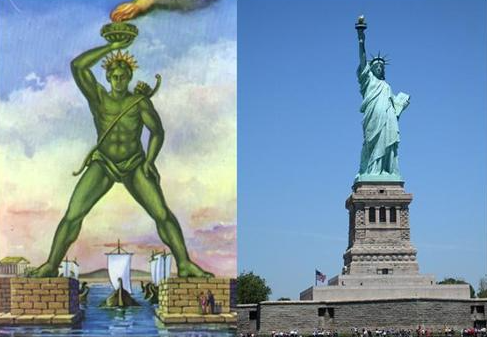
The sun god tradition is thoroughly pagan in nature and, in truth, is often connected to none other than Satan himself. When Lazarus’ poem refers to the statue as the “New Colossus,” this refers specifically to the Colossus of Rhodes. This statue was erected on the Greek Island (and city) of Rhodes to commemorate the defense of Rhodes from Macedonian forces, and it stood roughly 108 feet tall. Not surprisingly, it was one of the Seven Wonders of the Ancient world. It depicted the Greek sun god, Helios, and it possessed radiant sun rays that protruded from its head.

Helios was not only depicted on this monument but can also be seen in certain ancient inscriptions. When compared to the Statue of Liberty, the similarities are undeniable. The Statue of Liberty looks nearly identical to the ancient sun god and is even called the “(New) Colossus.”

Imagine that: a Masonic symbol existing right here in America that is clearly connected to Lucifer. Who would have thought?

Though much more could be said about the origins and symbolism behind Lady Liberty, this should reveal plenty. The truth is that Freemasons sold Lady Liberty to the masses (and still do) as a symbol of freedom, dressing her as a beacon of light and liberty to the peoples of the earth. Like all things in Freemasonry, the truth is veiled for the “ignorant masses,” and what they really accomplished is their beacon to the world shining from the very entrance to their New Atlantis, their Great Work, and the fulfilment of their Quest.

Even the notion of the statue being a woman at all is very much in question. In this sense, the figure is perhaps best understood as being androgynous, something that would align with the upside-down world of Freemasonry. Here, again, they achieved their goal of marking America as a nation dedicated to Satan (the “sun god”) while projecting the virtues of goodness, mercy, justice and peace to the world.

As we have all heard before, the devil is in the details.

Not surprisingly, the nation’s capital also bears the distinct marks of Freemasonry. When you connect the dots between monuments and buildings within the city, all the expected symbols appear: a pyramid, the Square and Compass, and the Masonic cross.[2] Curiously, the Capital Building itself is constructed to reveal an enormous owl. While the owl was seen in some Greek traditions as a symbol of wisdom, it was largely not so in the ancient world.

In both Egypt and Rome—cultures that are heavily present within the architecture of Washington D.C.—the owl took on a much darker meaning. It was believed to be a force associated with darkness and death, and the Egyptians viewed owls as the guardians of the underworld.[3] Not surprisingly, the owl has special significance for both the Freemasons and the Illuminati, as it a symbol of wisdom and hidden knowledge.

When we peer inside the Capital Building, we see a plethora of other signs and symbols. The painting that is suspended 180 feet above the rotunda depicts George Washington as a god and is called the “Apotheosis of Washington.” An apotheosis is the elevation to the status of a god. Hence, the fresco’s title literally means “the deification of Washington” or his “ascent to become a god.” In it, Washington is seen sitting atop the clouds, surrounded by a host of mythological deities. This is clearly something of a comparison with Zeus, who was believed to rule over the pantheon of Gods at Mount Olympus.

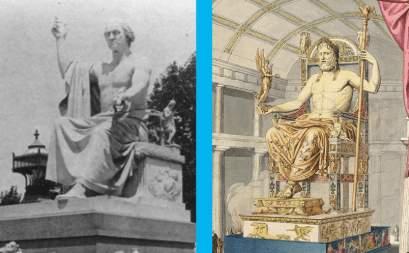
Washington is also depicted as a god (Zeus, specifically) within Horatio Greenough’s 1840 sculpture—called “Enthroned Washington”—that once sat within the rotunda of the United States Capitol and is now housed within the Smithsonian Museum.[4] It was a recreation of the great statue of Zeus at Olympia. With Zeus being considered as the chief of the gods in Greek mythology, we see precisely what the aim was with Greenhough’s sculpture.

Also know that his work was commissioned directly by the US Congress and was awarded a federal commission, in case you might object that Greenhough acted independently. Like Lady Liberty, we have another celebrated structure that has its roots in Greek paganism.

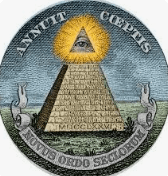
As though this were not enough, the Washington Monument—the tallest structure in Washington D.C., at 555 feet—also suggests the deity of George Washington. The monument is an Egyptian obelisk. In antiquity, obelisks were representations (and you guessed it) of the sun god, Ra.[5] The pyramidion, or capstone, of the obelisk represents the All-Seeing Eye. The All-Seeing Eye: you know, the exact same symbol that appears as the capstone of the Egyptian pyramid on the U.S. one dollar bill.

Is this making sense yet?

Speaking of the U.S. one-dollar bill, it cannot—at this point—come as a surprise that it is littered with Masonic/Satanic imagery and symbolism. The first one-dollar bill was issued in 1862 and featured the likeness of Salmon P. Chase, who was the secretary of Treasury under Abraham Lincoln. Seven years later, in 1869, it was redesigned and, among its changes, was that it would now bear the image of George Washington. Over the course of time, many new versions would be created and numerous little “wrinkles,” we’ll call them, found their way onto the dollar bill.[6]

We already discussed the All-Seeing Eye that sits atop its Egyptian pyramid. If we weren’t so used to it, the presence of an Egyptian pyramid should alone give us pause. Why is it even there on the American currency? In any event, there is much more for the eye to “see.”

A lesser-known issue with the pyramid is that there are 13 levels leading up to the capstone. This number is extremely significant within Freemasonry, as it can represent rebirth and it aligns with the exact day (Friday the 13th) that the Knights Templar were burned at the stake in 1307.[7] The Knights Templars are historically linked with the modern Freemasons and even marks its highest degree within the York Rite branch of the fraternity.

There are many other related symbols as well, including 13 leaves and olive branches, 13 bars and stripes on the shield, 13 feathers in the bird’s tail, 13 arrows, 13 stars in the crest above the bird, and more. Below the pyramid, a banner states the term “novus ordo seclorum,” which in Latin means “a new order of the ages.”

You may recall the events of 2020 and the world powers insisting that it marked a time for a Great Reset or, what they sometimes openly called, a New World Order.

Furthermore, we see that the “eagle” on the dollar bill strongly resembles certain ancient depictions of the Egyptian god, Horus, which can be traced back to the All-Seeing Eye that of course exists on the back side of the dollar bill as well. Even this “eagle” is representing a phoenix (or Horus) rising from the ashes.

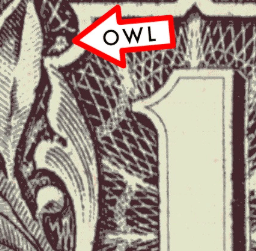
You have heard the expression, “I will rise like a phoenix from the ashes,” right? This speaks to the concept of Horus’s mythic defeat of his uncle Set (the god of chaos) that would avenge his father Osiris and reclaim the throne. While many protest this idea, and others mentioned here, even the Masonic owl makes an appearance at the top-left corner of the number one, on the top-right of the front side of the bill.

All this, and so much more, can be found on the dollar bill.

Lastly, there is the obvious point that the dollar bears the likeness of George Washington, who we have already seen has the clearest ties to Freemasonry and, by extension, the Satanic cult. The same man who is literally deified in myriad ways within the structures of Washinton D.C. adorns what is perhaps the most mysterious of U.S. symbols.

It all adds up.

Still, the backside of the dollar bill delivers its diversion in the plainest of ways saying, “In God We Trust.” With all the rest of the symbols we have seen, one simply must wonder which “God” this is referring to?

In truth, the deity that is clearly seen on the bill is Lucifer, and in the many ways already mentioned. The dollar bill is a perfect illustration of the world’s continuation of the Babylonian Mystery religion which manifests in endless ways within countless cultures and traditions. This corresponds perfectly with the Masonic ideas of a Great Work or a New Atlantis.

If only “Lady Liberty” were also covering one eye.


[1] This and the rest of the information presented here is taken from Calloway’s, “Secrets Exposed: the Statue of Liberty.”

[2] See “Secret Revealed, Symbols of the Freemason’s: Washington DC.”

[3] Ibid.

[4] See “Horatio Greenough’s George Washington.”

[5] Ibid. “Secret Revealed.”

[6] See “United States one-dollar bill.”

[7] Harris, “The Meaning of Hidden Symbols on the Dollar Bill in 5 Minutes.”