–
It has been quite some time since I last posted. This is partly because of the overall flow of my life recently, but also because I have been pouring my spare time into a new book (available in early 2026, hopefully) and continuing to make videos for the narcissism channel.
However, I felt especially compelled to make extra time to write this article. Those who keep up with this site know that I have been writing about the last days—which I do believe are upon us—in myriad ways since the events of 2020. Recently, I have come to see an important part of the picture that I had not previously given enough attention to.
This part of the picture is that the last days look very little like what most people have been taught.
For most, any discussion about the “end” revolves around (or at least culminates in) a time in which the Great Tribulation gives rise to utter chaos. Let’s be blunt: the end is believed to be nothing short of hell on earth. This is normally cashed out as a period of unparalleled bloodshed, a world ablaze by fire and destruction, and the type of world that can barely sustain human life.
If you have ever seen the film Terminator 2: Judgement Day and Sarah Connor’s vision of the world’s apocalyptic doom then, yeah . . . it’s that: total carnage and destruction, the likes of which we could barely comprehend.
In this article, I want to prove to you why that type of view is most emphatically not how the Bible portrays the last days. At least, it won’t be the overall state of the world prior to Jesus’ coming. To the contrary, the end will be something just as easy to perceive for those with eyes to see but will be impossible to see for those without them.
Let’s look at how this will really go down.
___________________
Images of Destruction
Before getting to the three major points we need to discuss, I must briefly address where all the “post-apocalyptic world” talk comes from: where the belief of a totally scorched earth scenario is derived from.
First, I want to be clear that the last days do involve physical hardships, violence, tribulation, and the like, to a certain degree. The twentieth century saw by far more casualties from war (globally) than any other in history. Though it varies, a solid estimate of the total deaths between the year 1900 and the present is about 187 million casualties.
Without question, most of these came in the 20th century. Talk about “wars and rumors of wars” (Mt. 24:6)! In this sense, there is clearly a sufficient amount of physical violence—in my estimation—to satisfy any amount of physical carnage expected in the tribulation of the last days.
Jesus speaks to this directly, of course. We are told about those wars and rumors of wars, that nations will rise against one another, and that it will be a time of terror in certain respects.
But exactly how bad will that part of things be? One of the mysterious aspects of Jesus’ descriptions of the last days—as in Matthew 24 and Luke 21, for instance—is that he is simultaneously addressing both the events surrounding the fall of the temple/Jerusalem and the events preceding the last days. For this reason, it is sometimes unclear which event he is speaking about. Jesus seems to address these two issues at the same time, seemingly vacillating between them at points.
Matthew 24:4-14, for example, seems to be directly speaking about the events of the last days. The prophecies about the gospel being preached throughout the entire world and the need to “stand firm” to the end cannot apply to the fall of Jerusalem (24:13-14). I don’t think any of that section can or does, for that matter.
However, verse 15 seems to abruptly pivot to a discussion about the fall of Jerusalem. Jesus’ comment about “the abomination that causes desolation” can only refer to the time when the temple existed (prior to AD 70). Further, his mention of the Sabbath is another clear indication that we are dealing with issues pertaining to the first century and not the last days; such a prospect would only make a difference locally, and by those who were bound under the law to keep the Sabbath (I discuss the Sabbath in this article).
There are many other points that could be made, but the point should be clear. Jesus’ handling of the two issues is not purely done in a chronological manner. Like Revelation, issues and time periods tend to jump around a bit. This means that Jesus’ statements about no flesh surviving “if those days had not been cut short” (24:22) and the distress of that time being unparalleled in all human history (24:21) logically pertain to the fall of Jerusalem. The latter is directly connected to issues pertaining to the abomination of desolation and the Sabbath. The Pulpit Commentary has this right:
“There should no flesh be saved; i.e. the whole Jewish nation would have been annihilated” (my emphasis).
The verdict, then, is that Jesus was not telling his audience that the last days would be some type of post-apocalyptic world. It will surely be bad, but not in that way. Furthermore, there has been unparalleled bloodshed throughout the last 120 years, as it is.
There are certainly physical implications of terror and bloodshed associated with the end. However, I think something else entirely speaks mainly to the state of the world in the last days.
________________
The Days of Noah
While the exact degree of tangible carnage, death and destruction of the end is somewhat hazy, something else Jesus said could not be clearer.
At one point, Jesus tells his listeners exactly what the last days will be like, and it involves the distant past:
“But about that day and hour no one knows, not even the angels of heaven, nor the Son, but the Father alone. For the coming of the Son of Man will be just like the days of Noah.For as in those days before the flood they were eating and drinking, marrying and giving in marriage, until the day that Noah entered the ark,and they did not understand until the flood came and took them all away; so will the coming of the Son of Man be” (24:36-39, my emphasis).
There we have it.
Jesus unequivocally stated that his coming—that is, the events surrounding the return and its very nature—will be exactly like it was during the days of Noah. And what was that like? Well, many things could be said on that front. For one thing, the “Nephilim” were alive on the earth in those days and the world was exceedingly corrupt (as it is now, I believe). But Jesus specifically mentions eating, drinking, marriage, and the like.
But why would he talk about those things?
Eating and drinking are the most ordinary (and necessary) aspects of life that one could mention. Only activities like sleeping and breathing would fall into the same category. However, he also mentions marriage. Marriage, as you should recall, was the institution and covenant that God created at the very beginning. It was to be the culmination of God’s design for man and woman and the modus operandi for how life would proceed throughout the entire age. Year after year, people have tied the knot and perpetuated human existence by creating families.
(That was the design, at least, but this clearly doesn’t operate as planned most of the time today).
What, then, was Jesus trying to say when he likened the last days to the days of Noah and the eating, drinking, marrying, etc.? I think it’s quite clear. As the Expositor’s Commentary accurately states:
“The idea rather seems to be that all things went on as usual, as if nothing were going to happen.”
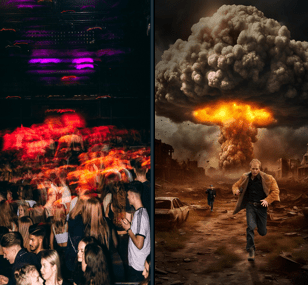
That’s right. Here, Jesus revealed something incredible: something that runs almost completely contrary to what most expect to see in the end. He said that the end would actually look like life as usual. People would be living their lives as though nothing spectacular is occurring at all. No Terminator 2 global chaos. No scorched earth scenarios. No anything of the sort.
In fact, it would appear to most that absolutely nothing was about to happen.
While the Bible does not directly state that others scoffed at Noah for building the Ark—contrary to popular belief—it is certainly reasonable to infer that such a thing occurred. Whatever the case, no one besides Noah and his family were preparing for the cataclysm. As far as the rest of the world was concerned, it was business as usual.
And that is exactly how Jesus describes the end. It is a period when only the righteous—those with eyes to see and ears to hear—will understand what is coming, and the rest of the world will continue on their merry way; they will be completely oblivious to the fact that Jesus’ coming is near.
In a sense, most of the world will exist in a spiritual slumber. They will be blind to the mass matrix of lies and deceptions spiraling around them. They will truly live in darkness, believing they will always have tomorrow and, as we will see next, they will even believe that they are safe from all manner of destruction.
(I have written an entire article showing that our current world fits the bill for Jesus’ prophecy in spades. I direct you there for more on this.)
________________
Peace and Safety
If Jesus’ description of the last days surprised you, then you will be completely stunned by Paul’s. Though it is clearly in line with Jesus’, it takes the days of Noah concept to another level altogether.
“Now as to the periods and times, brothers and sisters, you have no need of anything to be written to you. For you yourselves know full well that the day of the Lord is coming just like a thief in the night. While they are saying, “Peace and safety!” then sudden destruction will come upon them like labor pains upon a pregnant woman, and they will not escape. But you, brothers and sisters, are not in darkness, so that the day would overtake you like a thief” (1 Thes. 5:1-4).
Jesus displayed a world that is not obviously out of sorts—at least not in a physical sense. Paul has now added to that idea, saying that the days preceding the end will even appear to be times of “peace and safety!”
(Ironically, this has long been a common mantra within the Trump presidency.)
Paul’s perspective is leagues apart from the expectations that most Bible-believing Christians hold about the last days. In fact, it’s literally the opposite. A world of peace and safety is the most powerful contrast imaginable to a world of fire and chaos, is it not?
Are you beginning to see the problem?
______________
Like a Thief in the Night
There is a final aspect to consider, and it adds tremendous weight to the previous points. The NT repeatedly compares the return of the Lord with the way that a thief comes in the night. Referring to his coming, Jesus said:
“But know this, that if the master of the house had known in what part of the night the thief was coming, he would have stayed awake and would not have let his house be broken into” (Mt. 24:43).
This is further solidified in what Jesus is recorded as saying late within the Book of Revelation:
“Behold, I am coming like a thief! Blessed is the one who stays awake, keeping his garments on, that he may not go about naked and be seen exposed” (16:15)!
Not surprisingly, Paul also made mention of this in the same passage where he referred to the last days as a time of “peace and safety”:
“For you yourselves are fully aware that the day of the Lord will come like a thief in the night” (1 Thes. 5:4).
The biblical backing for the end coming as a thief in the night is beyond dispute. But what does it mean? We know that, as a matter of strategy, a thief comes at night—usually in the wee hours—because that is the time when he is least expected. Most people are asleep at that time and are not expecting him to come.
This is precisely how the end will be. It is a world where the vast majority of people are in a slumber—a spiritual slumber—and so they are ill-prepared for Jesus’ coming. He will catch them off guard, just as a thief catches the unsuspecting members of the household he is robbing off guard. Barne’s Notes drives this point home in emphatic fashion:
“A thief in the night – Suddenly and unexpectedly, as a robber breaks into a dwelling. A thief comes without giving any warning, or any indications of his approach. He not only gives none, but he is careful that none shall be given. It is a point with him that, if possible, the man whose house he is about to rob shall have no means of ascertaining his approach until he comes suddenly upon him.”
Ask yourself this question: would such a coming be possible in a world that screams chaos, death and destruction for all the world to plainly see?
________________
The Surprising Truth about the Last Days
Having looked at the previous descriptions given to us by Jesus and Paul, you may be questioning how the last days have been explained to you in the past. Most of us have understood this to be a time where bodies will line the streets, fire and smoke will fill the air, and screams will be heard from all over the earth.
Let me state this as clearly as possible: if the years preceding the last days were so obviously and overwhelmingly wrought with physical destruction, death, mutiny and carnage, then there is no way that people could be saying “Peace and safety!”
There is no way that the world could be reminiscent of the days of Noah, with people living their lives (seemingly) as normal, believing there is more time, thinking they were living in a time of stability, and having no obvious, tangible reason to expect that sudden destruction was coming upon them.
Lastly, there is no way that Jesus’ coming could overtake most of the world as a thief in the night. This idea further speaks to a serene and at least somewhat stable condition within the world; people will have no reason to think that Jesus is returning, and so they slumber away.
All this is precisely why Jesus warned his followers to stay awake; he knew that most would be asleep.
The surprising truth about the last days is that so few will even suspect that anything is awry. Those with eyes to see and ears to hear—that is, those with genuine spiritual discernment in the Lord—will recognize that the world is utterly corrupt and out of sorts. However, those on the wide path to destruction will be completely unaware that the end is quickly approaching.
This, dear friends, is the very world that we are now living in. Up is down, right is wrong, and the corruption that exists within our world can only rightly be compared to the time when God was forced to destroy the world through water.
This time, however, it will be through fire:
“But the day of the Lord will come like a thief, and then the heavens will pass away with a roar, and the heavenly bodieswill be burned up and dissolved, and the earth and the works that are done on it will be exposed” (2 Pet. 3:10, my emphasis).
Stay alert and keep watch, for we know not when the master of the house will return.
–
To see more about why I really think we are nearing the end and living in the time described within this article, see the articles below.

 Angels-Aliens
Brian, great article on the end times! I appreciate your thorough work on it. Our world is getting more corrupt & darker. Jesus has to be coming soon!
LikeLike
Brian, great article on the end times! I appreciate your thorough work on it. Our world is getting more corrupt & darker. Jesus has to be coming soon!
LikeLike
Brian, great article on the end times! I appreciate your thorough work on it. Our world is getting more corrupt & darker. Jesus has to be coming soon!
LikeLike
Brian, thank you for your article on the end times. You are keeping it real. A.I. is scary to me. Someone said 80% of what we see is A.I. And that it will be even more down the road. It’s hard to know what is real any more! Jill Wanamaker
LikeLike
Another great article. I cannot wait for your book to come out!
LikeLike
Thanks Julie!
LikeLiked by 1 person
Many good points, worthy of thought. Noteworthy to me is the “spiritual slumber” that you mention.
LikeLike
Thanks Jorge! That is my take on this, at least. Makes sense because Jesus can’t come as a thief if the end is obvious to everyone, particularly those who aren’t in him.
LikeLike