–
For some time now, I have been spending a tremendous amount of time working on a book. My hope is that it will be my best work to date.
This is, in part, why I have not released many blogs in recent times.
Now that I am getting closer to having this goliath finished, I wanted to start providing small sections as something of a sneak preview of the book. What follows is a rather provocative section showing some of the many indications that our country was indeed founded by the Freemasons, the very church of Satan and the force that largely drives our world.
If you find this interesting, then you will likely find the book interesting as well. Enjoy!
___________________
Masonic America
Scattered throughout the most significant locations in the United States, we see the hallmarks of Freemasonry . . .
These signs appear as all other things within the Masonic enterprise: veiled beneath the trappings of kindness, mercy, justice and beauty. Take Lady Liberty, for example. On a rainy October day in 1886, the Statue of Liberty was unveiled. Before that, however, much took place to make this a reality. In 1883, Emma Lazarus wrote the poem, “The New Colossus,” to help raise money for the statue’s pedestal. In 1903, its most recognized lines were engraved upon a bronze plaque inside the pedestal:
“Give me your tired, your poor,
Your huddled masses yearning to breathe free,
The wretched refuse of your teeming shore,
Send these, the homeless, tempest-tossed to me,
I lift my lamp beside the golden door!”
The Stature of Liberty, as the poem suggests, has long been believed to be a symbol of friendship, unity, and of course liberty; it is seen as a beacon of freedom and opportunity to all who wish to enter America.
The Statue of Liberty is probably the single-most identifiable structure that symbolizes the United States; it is what most people, both within and outside of the country, think of when America comes to mind. It is typically taught and maintained that the statue was a gift from France to symbolize their friendship and support.
The truth about the structure, however, is rather different.
The monument was the brainchild of Frédéric Auguste Bartholdi, a French sculptor and painter. Bartholdi wanted to build a grand and memorable structure, and so he traveled to Egypt (among other countries) for inspiration. In 1869, the Egyptian Ruler, Isma’il Pasha—who had previously enjoyed Bartholdi’s work—commissioned him to create a monument that would be placed at the northern side of the Suez Canal in Egypt.[1]
Bartholdi’s intentions, then, were to create a massive lighthouse that would be a personification of Egypt. It was designed to be a towering “fellah” (a male or female peasant) dressed in Islamic style clothing, and the structure would be called “Egypt Enlightening the Orient.” Pasha, however, halted the project because it was proving to be both time and cost prohibitive, among other factors.
After a series of hazy events, Bartholdi later became associated with none other than the Freemasons in his native country of France. During a trip to the U.S. in 1871, he had the revelation of the ideal site for his monument: Bedloe Island, or what is now called Liberty Island. In 1874, Bartholdi helped to establish—under the Masonic agenda—a group called the Franco-American Union.
This group was able to sell influential American figures on Bartholdi’s dream, but now under the guise of aligning with the principles of 1871’s U.S. Constitution.
The Franco-American Union was tasked with selling the idea to the public and raising the required funds to transport the monument in various pieces to America. Hence, the Statue of Liberty was not a gift from France but was a Masonic endeavor to call specific groups of immigrants—through the “light” of the statue’s torch—to their new world.
Now, also shining atop the statue’s head, are seven rays that symbolize the seven continents of the world. These rays hearken back to Bartholdi’s travels and the ancient fascination with the “sun god.” The ancient Egyptians called him “Ra” (or “Re”), while he is identified with many other names in antiquity.
The sun god tradition is thoroughly pagan in nature and, in truth, is often connected to none other than Satan himself. When Lazarus’ poem refers to the statue as the “New Colossus,” this refers specifically to the Colossus of Rhodes. This statue was erected on the Greek Island (and city) of Rhodes to commemorate the defense of Rhodes from Macedonian forces, and it stood roughly 108 feet tall. Not surprisingly, it was one of the Seven Wonders of the Ancient world. It depicted the Greek sun god, Helios, and it possessed radiant sun rays that protruded from its head.
Helios was not only depicted on this monument but can also be seen in certain ancient inscriptions. When compared to the Statue of Liberty, the similarities are undeniable. The Statue of Liberty looks nearly identical to the ancient sun god and is even called the “(New) Colossus.”
Imagine that: a Masonic symbol existing right here in America that is clearly connected to Lucifer. Who would have thought?
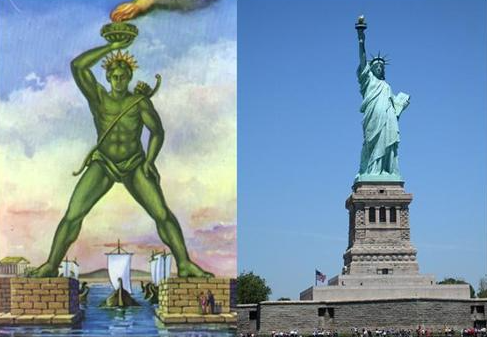
See any similarities?
Though much more could be said about the origins and symbolism behind Lady Liberty, this should reveal plenty. The truth is that Freemasons sold Lady Liberty to the masses (and still do) as a symbol of freedom, dressing her as a beacon of light and liberty to the peoples of the earth. Like all things in Freemasonry, the truth is veiled for the “ignorant masses,” and what they really accomplished is their beacon to the world shining from the very entrance to their New Atlantis, their Great Work, and the fulfilment of their Quest.
Even the notion of the statue being a woman at all is very much in question. In this sense, the figure is perhaps best understood as being androgynous, something that would align with the upside-down world of Freemasonry. Here, again, they achieved their goal of marking America as a nation dedicated to Satan (the “sun god”) while projecting the virtues of goodness, mercy, justice and peace to the world.
As we have all heard before, the devil is in the details.
Not surprisingly, the nation’s capital also bears the distinct marks of Freemasonry. When you connect the dots between monuments and buildings within the city, all the expected symbols appear: a pyramid, the Square and Compass, and the Masonic cross.[2] Curiously, the Capital Building itself is constructed to reveal an enormous owl. While the owl was seen in some Greek traditions as a symbol of wisdom, it was largely not so in the ancient world.
In both Egypt and Rome—cultures that are heavily present within the architecture of Washington D.C.—the owl took on a much darker meaning. It was believed to be a force associated with darkness and death, and the Egyptians viewed owls as the guardians of the underworld.[3] Not surprisingly, the owl has special significance for both the Freemasons and the Illuminati, as it a symbol of wisdom and hidden knowledge.
When we peer inside the Capital Building, we see a plethora of other signs and symbols. The painting that is suspended 180 feet above the rotunda depicts George Washington as a god and is called the “Apotheosis of Washington.” An apotheosis is the elevation to the status of a god. Hence, the fresco’s title literally means “the deification of Washington” or his “ascent to become a god.” In it, Washington is seen sitting atop the clouds, surrounded by a host of mythological deities. This is clearly something of a comparison with Zeus, who was believed to rule over the pantheon of Gods at Mount Olympus.
Washington is also depicted as a god (Zeus, specifically) within Horatio Greenough’s 1840 sculpture—called “Enthroned Washington”—that once sat within the rotunda of the United States Capitol and is now housed within the Smithsonian Museum.[4] It was a recreation of the great statue of Zeus at Olympia. With Zeus being considered as the chief of the gods in Greek mythology, we see precisely what the aim was with Greenhough’s sculpture.
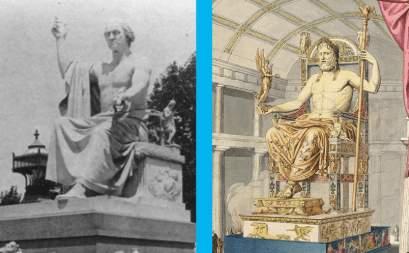
Also know that his work was commissioned directly by the US Congress and was awarded a federal commission, in case you might object that Greenhough acted independently. Like Lady Liberty, we have another celebrated structure that has its roots in Greek paganism.
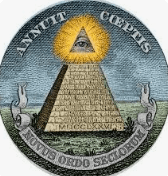
As though this were not enough, the Washington Monument—the tallest structure in Washington D.C., at 555 feet—also suggests the deity of George Washington. The monument is an Egyptian obelisk. In antiquity, obelisks were representations (and you guessed it) of the sun god, Ra.[5] The pyramidion, or capstone, of the obelisk represents the All-Seeing Eye. The All-Seeing Eye: you know, the exact same symbol that appears as the capstone of the Egyptian pyramid on the U.S. one dollar bill.
Is this making sense yet?
Speaking of the U.S. one-dollar bill, it cannot—at this point—come as a surprise that it is littered with Masonic/Satanic imagery and symbolism. The first one-dollar bill was issued in 1862 and featured the likeness of Salmon P. Chase, who was the secretary of Treasury under Abraham Lincoln. Seven years later, in 1869, it was redesigned and, among its changes, was that it would now bear the image of George Washington. Over the course of time, many new versions would be created and numerous little “wrinkles,” we’ll call them, found their way onto the dollar bill.[6]
We already discussed the All-Seeing Eye that sits atop its Egyptian pyramid. If we weren’t so used to it, the presence of an Egyptian pyramid should alone give us pause. Why is it even there on the American currency? In any event, there is much more for the eye to “see.”
A lesser-known issue with the pyramid is that there are 13 levels leading up to the capstone. This number is extremely significant within Freemasonry, as it can represent rebirth and it aligns with the exact day (Friday the 13th) that the Knights Templar were burned at the stake in 1307.[7] The Knights Templars are historically linked with the modern Freemasons and even marks its highest degree within the York Rite branch of the fraternity.
There are many other related symbols as well, including 13 leaves and olive branches, 13 bars and stripes on the shield, 13 feathers in the bird’s tail, 13 arrows, 13 stars in the crest above the bird, and more. Below the pyramid, a banner states the term “novus ordo seclorum,” which in Latin means “a new order of the ages.”
You may recall the events of 2020 and the world powers insisting that it marked a time for a Great Reset or, what they sometimes openly called, a New World Order.
Furthermore, we see that the “eagle” on the dollar bill strongly resembles certain ancient depictions of the Egyptian god, Horus, which can be traced back to the All-Seeing Eye that of course exists on the back side of the dollar bill as well. Even this “eagle” is representing a phoenix (or Horus) rising from the ashes.
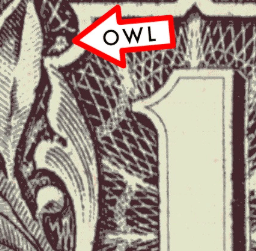
You have heard the expression, “I will rise like a phoenix from the ashes,” right? This speaks to the concept of Horus’s mythic defeat of his uncle Set (the god of chaos) that would avenge his father Osiris and reclaim the throne. While many protest this idea, and others mentioned here, even the Masonic owl makes an appearance at the top-left corner of the number one, on the top-right of the front side of the bill.
All this, and so much more, can be found on the dollar bill.
Lastly, there is the obvious point that the dollar bears the likeness of George Washington, who we have already seen has the clearest ties to Freemasonry and, by extension, the Satanic cult. The same man who is literally deified in myriad ways within the structures of Washinton D.C. adorns what is perhaps the most mysterious of U.S. symbols.
It all adds up.
Still, the backside of the dollar bill delivers its diversion in the plainest of ways saying, “In God We Trust.” With all the rest of the symbols we have seen, one simply must wonder which “God” this is referring to?
In truth, the deity that is clearly seen on the bill is Lucifer, and in the many ways already mentioned. The dollar bill is a perfect illustration of the world’s continuation of the Babylonian Mystery religion which manifests in endless ways within countless cultures and traditions. This corresponds perfectly with the Masonic ideas of a Great Work or a New Atlantis.
If only “Lady Liberty” were also covering one eye.
(For more on Freemasonry and the All-Seeing Eye, start here.)
_
[1] This and the rest of the information presented here is taken from Calloway’s, “Secrets Exposed: the Statue of Liberty.”
[2] See “Secret Revealed, Symbols of the Freemason’s: Washington DC.”
[3] Ibid.
[4] See “Horatio Greenough’s George Washington.”
[5] Ibid. “Secret Revealed.”
[6] See “United States one-dollar bill.”
[7] Harris, “The Meaning of Hidden Symbols on the Dollar Bill in 5 Minutes.”
 Angels-Aliens