(I discuss this and much more in my new book, Order of the Eye: The Secret Force that Runs the World. It is available in both paperback and eBook formats)
Among the many things that simply aren’t what they appear to be is the most iconic symbol in American history: The Statue of Liberty.
In this short article, I describe the true origins of “Lady Liberty” and how the monument stands for something entirely different than what we have always been taught. This is taken directly from Order of the Eye.
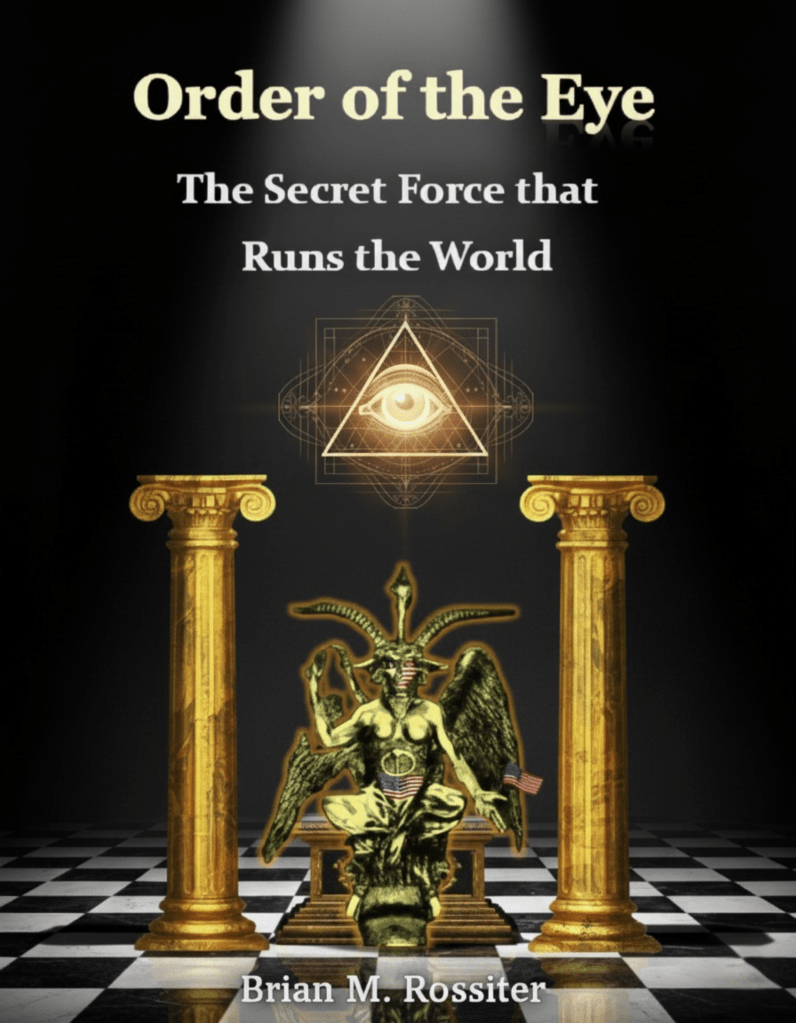
If you find this interesting, this text discusses many more oddities that exist within the United States that speak directly to who runs things.
May your eyes be opened.
_______________
On a rainy October day in 1886, the Statue of Liberty was unveiled. Before that, however, much took place to make this possible. In 1883, Emma Lazarus wrote the poem, “The New Colossus,” to help raise money for the statue’s pedestal. In 1903, its most recognized lines were engraved upon a bronze plaque inside the pedestal:
“Give me your tired, your poor,
Your huddled masses yearning to breathe free,
The wretched refuse of your teeming shore,
Send these, the homeless, tempest-tossed to me,
I lift my lamp beside the golden door!”
The Stature of Liberty, as the poem suggests, has long been believed to be a symbol of friendship, unity, and of course liberty; it is seen as a beacon of freedom and opportunity to all who wish to enter America.
The Statue of Liberty is probably the single-most identifiable structure that symbolizes the United States; it is what most people, both within and outside of the country, think of when America comes to mind. It is typically taught and maintained that the statue was a gift from France to symbolize their friendship and support.
The truth about the structure, however, is rather different.
The monument was the brainchild of Frédéric Auguste Bartholdi, a French sculptor and painter. Bartholdi wanted to build a grand and memorable structure, and so he traveled to Egypt (among other countries) for inspiration. In 1869, the Egyptian Ruler, Isma’il Pasha—who had previously enjoyed Bartholdi’s work—commissioned him to create a monument that would be placed at the northern side of the Suez Canal in Egypt.[1]
Bartholdi’s intentions, then, were to create a massive lighthouse that would be a personification of Egypt. It was designed to be a towering “fellah” (a maleor femalepeasant) dressed in Islamic style clothing, and the structure would be called “Egypt Enlightening the Orient.” Pasha, however, halted the project because it was proving to be both time and cost prohibitive, among other factors.
After a series of hazy events, Bartholdi later became associated with none other than the Freemasons in his native country of France. During a trip to the U.S. in 1871, he had the revelation of the ideal site for his monument: Bedloe Island, or what is now called Liberty Island. In 1874, Bartholdi helped to establish—under the Masonic agenda—a group called the Franco-American Union. This group was able to sell influential American figures on Bartholdi’s dream, but now under the guise of aligning with the principles of 1787’s U.S. Constitution.
The Franco-American Union was tasked with selling the idea to the public and raising the required funds to transport the monument in various pieces to America. Hence, the Statue of Liberty was not a gift from France but was a Masonic endeavor to call specific groups of immigrants—through the “light” of the statue’s torch—to their new world.
Now, also shining atop the statue’s head, are seven rays that symbolize the seven continents of the world. These rays hearken back to Bartholdi’s travels and the ancient fascination with the “sun god.” The ancient Egyptians called him “Ra” (or “Re”), while he is identified with many other names in antiquity. The sun god tradition is thoroughly pagan in nature and, in truth, is often connected to none other than Satan himself.
When Lazarus’ poem refers to the statue as the “New Colossus,” this refers specifically to the Colossus of Rhodes. This statue was erected on the Greek Island (and city) of Rhodes to commemorate the defense of Rhodes against Macedonian forces, and it stood roughly 108 feet tall. Not surprisingly, it was one of the Seven Wonders of the Ancient world. It depicted the Greek sun god, Helios, and it possessed radiant sun rays that protruded from its head. Helios was not only depicted on this monument but can also be seen in certain ancient inscriptions.
When compared to the Statue of Liberty, the similarities are undeniable.
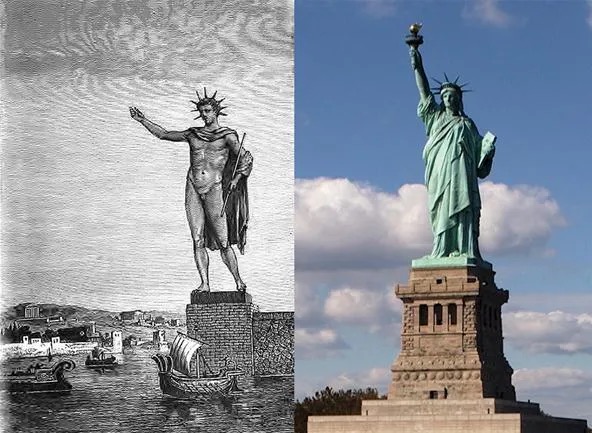
As you can see, the Statue of Liberty looks nearly identical to the ancient sun god and is even called the “(New) Colossus.” Imagine that: a Masonic symbol existing right here in America that is clearly connected to Lucifer. Who would have thought?
Though much more could be said about the origins and symbolism behind Lady Liberty, this should reveal plenty. The truth is that the Freemasons sold Lady Liberty to the masses (and still do) as a symbol of freedom, dressing her as a beacon of light and liberty to the peoples of the earth. Like all things within the Order, the truth is veiled for the “ignorant masses.”
What they really accomplished is their beacon to the world that shines from the very entrance to their New Atlantis, their Great Work, and the fulfilment of their Quest. Even the notion of the statue being a woman at all is very much in question. In this sense, the figure is perhaps best understood as being androgynous, something that would align with the upside-down world of Freemasonry.
Here, again, they achieved their goal of marking America as a nation dedicated to Satan (the “sun god”) while projecting the virtues of goodness, mercy, justice and peace to the world.
As we have all heard before, the Devil is in the details.
[1] This, and the rest of the information presented here, was taken from Calloway’s, “Secrets Exposed: the Statue of Liberty.”

