
(Pre-reading note: This is one my longer articles, but I assure you that it’s one of my most important. Please take the time to read and reflect on it)
For many years now, I have observed a great heresy growing within the church.
If you are familiar with my articles or books, then my exposure of heresies will come as no surprise to you. However, this is one unlike any other I have spoken against. In fact, I can safely say that—in my estimation—it’s the greatest heresy in all the world.
What if I told you that you can be saved while choosing to live a life of decadence and debauchery?
What if I said that we can abide in Christ while satisfying every carnal desire of the flesh?
What if I guaranteed you that there can be the everlasting assurance of life in God’s Kingdom, even if you chose to follow Satan and make sacrifices to the Baphomet on his behalf?
Naturally, I would never—Lord forbid—make such blasphemous and heretical claims. However, there are plenty of pastors and church leaders that are now doing that very thing.
Worse yet, these beliefs are becoming the normative “Christian” understanding of salvation. The Great Heresy of our time—and perhaps, of all time—has been around since the early church but is now reaching a fever pitch.
Its name? Free Grace Theology
(This is otherwise known as Easy Believism, or Hyper-Grace Theology).
In this article, I am going to describe to you the basic tenants of Free Grace theology and allow some of its many proponents to blow your mind with its logical implications. Afterwards, I will make a succinct case as to why this view is not only demonstrably false but is nothing short of Satan’s handiwork.
_____________
What is Free Grace Theology?
Free Grace theology, like any theological movement, displays a fair degree of diversity in thought and nuance. However, it’s imperative to stay on task and discuss the central tenants of the perspective.
The main pillar of Free Grace theology (FG, from here on) is that belief in Jesus alone saves and that nothing we do has any bearing on salvation. Thus, salvation is a free gift that is given to a person simply based upon their belief in Jesus and that belief alone. Here is how Free Grace International—a very prominent group that promotes this doctrine—summarizes this:
“Jesus offers salvation to us freely, yet this message continually gets muddied by many who say that our lives must look different and must be filled with good works. We believe that our lives should look different, but that this transformation comes through continual discipleship and sanctification, and the transformed life is not required to prove one’s salvation.”
Note the statement that our lives should look different once saved but are not required to. This will come up again in a later section (though you may already see the problem.)
Herein lies the crux of the argument. Pulling on specific verses or passages of Scripture, Free Grace proponents hold that salvation is obtained by believing in Jesus and has nothing whatsoever to do with our obedience, a visible change in lifestyle (i.e. transformation), or the manifestation of spiritual fruits. Below are a couple of the verses that are popularly quoted, though there are others:
“For by grace you have been saved through faith; and that not of yourselves, it is the gift of God; not a result of works, so that no one may boast” (Eph. 2:8-9, ESV).
“The one who believes in Him is not judged; the one who does not believe has been judged already, because he has not believed in the name of the only Son of God” (Jn. 3:18, NASB).
Moreover, salvation cannot be lost and is a guaranteed promise for all who have believed in Jesus. However, “belief” is a rather nebulous term in FG theology. While this is one of the nuances of the doctrine, it essentially means to accept the proposition that Jesus is Lord and that he died for our sins.
In other words, it is largely a mental acknowledgment and does not extend further into placing one’s ultimate trust in Christ or some stronger definition that would include action.
_____________
The Many Problems
To be sure, FG theology appears—at first blush—to not only be appealing but to even be consistent with Scripture. They do quote the Bible to make their case, after all.
However, the devil is once again in the details.
There are so many problems and so little time. Let me summarize several of them, and then point you toward the video resource I recently put together. The first problem is that FG theology is based upon isolating certain verses that fit their needs while either ignoring or distorting the ones that don’t. This practice is sometimes called “cherry-picking” in the theological community, and FG proponents are masters at it.
For example, they are eager to quote any passage the speaks about belief as being the only prerequisite in salvation but make no mention of the ones that describe additional requirements. For example, texts like John 3:16 and 3:36 are quoted because they speak only about belief, while texts that speak about the need to repent and/or be baptized—such as Mark 16:16 or Acts 2:38—are completely neglected. To them, repentance and baptism would be a “work” and, thus, would not be necessary even though the plain reading of the texts require it.
Speaking of works, FG proponents are happy to quote a text like Romans 3:28 but will openly ignore a text like James 2:24. The reason is simple: while Romans declares that justification comes by faith apart from the “works of the law,” James declares that a person is justified by both faith and works.
Based on their understanding of Scripture, the two verses are completely contradictory.
In reality, however, they are not at all. One only needs to understand that Paul was talking specifically about the “works of the law”—that is, the Mosaic Law of the OT—and not about all actions believers may be required to undertake. I explain this in detail within this video. In any event, they cannot make this distinction either because then, Paul’s words wouldn’t provide evidence in favor of their view. They must distort the meaning of passages that don’t align with FG doctrine, if they don’t outright ignore them.
This gets to the second problem I will address here, which is that they simply distort passages that don’t fit their agenda. James 2 is a great example. Instead of seeing James’ clear case that action must accompany belief in salvation, they twist the context to suggest that James was referring to being disciplined by God or not being approved by men for their lack of works.
Another example would be Matthew 7:21-23, which discusses the many people that will be turned away by Christ at the end. They actually make the case that the ones being condemned—who Jesus “never knew”—were the ones who thought their own works and obedience were necessary in salvation. You heard that right; those to whom Jesus will declare, “I never knew you; depart from me,” are individuals who believed their works factored into salvation.
This is a common FG view, even though the passage makes it clear what Jesus was talking about:
“And then will I declare to them, ‘I never knew you; depart from me, you workers of lawlessness.’
In declaring that these people were “workers of lawlessness,” it is clear that they were condemned for practicing corruption. So, in truth, this passage is saying precisely the opposite of what the FG camp thinks; evil works can condemn someone, even though they believe in Jesus. While they were doing good in the name of Jesus, they were evidently practicing evil in many aspects of their lives. This perfectly explains how many can be involved in ministry and claim Jesus their entire lives yet be rejected at the end.
After all, many are called but few are chosen (Mt. 22:14).
A third problem with FG theology is that they clearly confuse entering salvation with remaining in salvation. Since they love to use the account of the criminal on the cross (Lk. 23:39-43)—which is an anomaly and not a general teaching—to prove that all people can be saved by belief apart from action, I shall turn this example on them. It is true that the criminal entered salvation by virtue of his faith in Jesus, without having to bring obedience or good deeds with him.
However—and I can’t say this strongly enough—if the criminal had somehow been removed from the cross to live for some period of years afterwards, he would have been expected to be obedient and to produce fruit. In other words, entering salvation has nothing to do with our deeds but remaining in salvation certainly does.
This is precisely why using the criminal on the cross to prove anything about the general nature of salvation, the need (or lack thereof) to be baptized, etc., is a terrible hermeneutical practice.
Another way of characterizing this problem is to note that they make a hard break between justification and sanctification, to the extent that there is little or no connection between them. Justification is when we are declared righteous before God and our standing is instantly changed; apart from any additional works of our own, we have asked Jesus into our lives and, thus, have entered salvation through faith in him. This is what occurred with the criminal on the cross.
Sanctification, on the other hand, refers to the process of being made holy. This is the lifelong effect of cooperating with God to become more like Christ, and it absolutely involves dedication and obedience on our part.
There is much more that could be said about these concepts, but this provides a good summary of what is involved.
To FG supporters, sanctification need not ever exist in salvation. Being made holy is completely about the rewards we will receive in this life and the next, but it has nothing to do with being saved. They will sometimes describe any change we might show as a matter of discipleship, which is—surprise, surprise—advised but not required.
One would participate in discipleship to live a better life, to be of service to others, and to receive greater rewards . . . but it would not be done because it is necessary in salvation.
One final problem worth mentioning—while there are many more possibilities—is that Scripture is replete with crystal clear examples of where obedience, good works, and the need to bear fruit is both commanded and said to be essential in salvation. There are so many examples to mention that a separate blog would be in order. Fortunately, I have written such an article already. I refer you there if you need the evidence.
Overall, the FG perspective is highly selective, disingenuous, and demonstrably antithetical to the overall narrative of Scripture.
_____________
The Horrifying Implications
There are excellent reasons why I am so dedicated to exposing the Free Grace heresy for the deception that it is.
This perspective is the epitome of a false gospel, though they believe that Lordship Salvation—the view that Jesus must be the Lord of your life and that salvation must be accompanied by a transformed life—is the real heresy.
The Free Grace doctrine, then, is one that can lead to eternal damnation.
I do not say this lightly. Obviously, not every false teaching—or even every heresy—is a salvation issue. This, however, most definitely is. In fact, it’s the epitome of a salvation issue. This involves the very nature of salvation itself. If—as I have shown, and Scripture is clear about—salvation must result in a changed life, then accepting the Free Grace view can easily lead one to condemnation. Remember the quote from Free Grace International:
“We believe that our lives should look different, but that this transformation comes through continual discipleship and sanctification, and the transformed life is not required to prove one’s salvation.”
This, of course, means that one can technically continue to live a corrupt life—as I will show, a very corrupt life—without ever jeopardizing their salvation. Sure, transformation is preferable . . . but if it never happens? Ehh, so be it. There is a brutal reality attached to this:
If one truly believes they can be saved while persisting in a morally depraved life, then a morally depraved life one will live. It’s that simple.
This is the heart of the problem with Free Grace theology, and it’s the worst of all imaginable issues. However, let me very briefly show you how deep the rabbit hole descends.
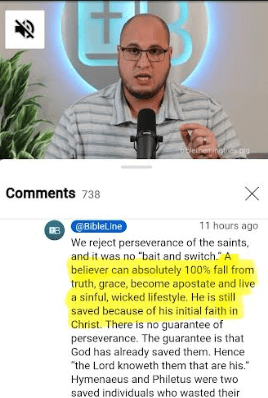
On one of the countless videos about FG theology made by pastor Jesse Martinez on his YouTube channel, Bibleline, I asked if one can become an utterly rebellious apostate and still be saved, so long as they “believe” in Jesus. Here was his response:
“A believer can absolutely 100% fall from truth, grace, become apostate and live a sinful, wicked lifestyle. He is still saved because of his initial faith in Christ.”
Don’t believe me about this exchange? Here is a screenshot I took of his response:
On another occasion, I asked the popular FG YouTuber, Ono Diamante, if a saved believer can endlessly live a life of sin. Here was his response:
“Yes. Even someone like you who disobeys God in thought, word or deed everyday can be saved.”
Here is the screenshot for that one:

Forgetting the condescending tone—which assumes that I am transgressing the laws of God everyday—Ono responded in the affirmative; yes . . . one can perpetually sin every day, and in all ways, but continue to be saved. No change or transformation ever needs to take place.
However, this cloud gets darker than you can imagine. Shawn Lazar—one of the leading “lights” (if you can call him that) of the FG gospel—made an astonishing admission in a debate about the nature of salvation. When asked if a person who believed in Christ as a child can later become a “God-hater” and a “satanist” who makes “sacrifices to the devil”—while still retaining his or her salvation—Lazar said this:
“Yes: once saved always saved. It takes just a second of belief in Jesus to have everlasting life.”
Lazar went on to explain that one can lose many of their heavenly rewards and much of what they have on this earth. But salvation itself? Never. Just believe for one moment that Jesus is Lord, and you can proceed to live as a satanist every day after.
In truth, I could share quotes like these for days, but I hope the point has been made.
Before concluding this section, I simply must point out an astonishing aspect of FG theology. Recall the earlier discussion about Matthew 7:21-23 and consider this. In their warped view of theology, the only thing that can disqualify someone from salvation—provided they believed in Jesus, if only for a moment—is to also believe that we must display a transformed life. That’s right: one can make sacrifices to Satan and retain their salvation, but they may not believe they are required to be obedient or produce fruit and retain it.
Really let that one sink in.
You may be wondering how anyone can believe, much less teach, such things. I mean, how can they go so far in affirming wicked behavior while condemning good? The answer is simple: they have to. If even a single work—much less a collection of works—can alter one’s salvation at any point, then works indeed have a part to play. For this reason, it must be possible for a saved individual to perform the most heinous crimes imaginable, and for as long as desired, without the fear of losing their salvation.
Alternatively, it must also be true that one could go their entire lives without doing a single good deed for the Kingdom and still participate in the resurrection of life (Jn. 5:28-29).
After all—and as they so often ask— how could anyone have assurance of their salvation if obedience is required? The better question is, how anyone can have assurance without it?
____________
Conclusion
I will keep this short, because much has been said already.
As I have demonstrated, the Free Grace movement is an abomination. It perverts the true Gospel of Christ, replacing it with the gospel of Satan. The matter could not possibly be more dire, either, as salvation itself is at stake. This is exactly why I believe—with all my heart—that the Free Grace/Easy Believe gospel is the most heretical teaching going today.
Do we need, as Christ and the apostles to clearly taught, to demonstrate our faith in action? Or, as the Free Grace crowd posits, can we make sacrifices to Satan all the way to the “pearly gates?”
Each time the fanciful pleas of the Free Grace heretics woo and entangle another convert to an unscriptural and illogical doctrine, I cannot help but see a glimpse into the hidden darkness where the Evil One resides.
There, in that darkness, he revels in the thought of this new child of wrath: a new son or daughter who believes they can act like Satan while being secure in Christ.
He counts the fruits of his labor, and smiles.
In closing, I pray you: do not fall victim to the Free Grace heresy. Do not take the broad path that most are on today. Instead, follow the narrow path that leads to life. Abide in Christ, obey his words, and demonstrate your faith in obedience to him.
Your salvation depends on it.
–
(If this topic is of interest to you, then I strongly suggest that you watch my video. It explains the role that believers really play in salvation.)

 Angels-Aliens
This is a very difficult area – far more difficult than may appear at first. Ultimately I think it’s a matter of ‘degree’ and overall spiritual orientation.
On one hand, it’s clear that a person cannot be of God and of the world at the same time – that is spiritually impossible. Stated differently, ‘serving two masters’ (God and the world) is not possible in the spiritual realm. Therefore, the ‘works’ of a person (i.e., the life the person lives in this world) must align with the “free gift” of salvation through Christ.
On the other hand, it is equally impossible for a person on Earth – living with the limitations and weaknesses of the flesh – to live a ‘perfect’ life, i.e., where ALL thoughts, words and actions are in total alignment with the “free gift” of salvation through Christ.
Every person sins every day – many times and in different ways – even in ways that we are unaware of. To argue against that point is to say that it’s possible for a person in their earthly flesh to live a totally sinless life in thoughts, words and deeds. Clearly, achieving that is an impossibility. That is why a NEW (sinless) body will be given in the afterlife to the saved in Christ — the old body (flesh; sin) must die (be destroyed and replaced).
That said, no believing, mature Christian ought to consider himself as possessing a ‘blank check’ for committing sin. That, I believe, is the basic difference between the Christian and the man of this world. The former is continuously restrained against sin, whereas the latter has no restraints towards sin. While the former may sin (and does sin), the latter does not even regard it as sin – he is free to do as he pleases (“do as thou wilt”) with no restrictions or laments.
Here’s a thought: to even attempt to live a sinless life is folly, and may even be blasphemous! Why? Consider a person who claims that he is, or will be, “sinless”. Well, that claim makes God a liar. (1 John 1: 8-10). Thus, Christ was necessary because of our sins – past, present and future. Accept it, we will sin in the days to come. But again, that does not give us a ‘blank check’ for sin.
This is a difficult area in Christian life. We do the best we can, completely trusting in HIM.
LikeLike
Hello Jorge,
I agree: this is a difficult matter. There are many factors involved, and none of us want to suggest that we have somehow “saved ourselves.”
I think there are two major points that often go completely missed. The first is that, when Paul talks about being saved by faith and not by works, he is always talking about the “works of the law.” That is, the Mosaic Law given within the OT covenant that was made with Israel. The major issue of the day was that Jewish converts were attempting to preach salvation that came through following Jesus AND also achieving righteousness through the now obsolete Mosaic Law. This is why he directly says, “works of the law” and mentions things like circumcision and sabbath keeping. He was NOT saying that our obedience to the New Covenant was unnecessary in salvation.
This gets to the second part, and it’s about Jesus’ purpose. Jesus came to pay, once and for all, for the sins of the world. He alone did this and, on that basis, no one could ever boast that we saved ourselves. Forgiveness was the free gift offered through Christ and could never be our own work. However, Jesus did not do our obedience for us. Forgiveness is free of requirements, but our part in the covenant is not. This is why we are so often warned that continuing in sin will lead to damnation and that each of us must carry our crosses and work out our salvation with fear and trembling. Jesus paid for our sins but did not do our obedience to his commands for us. Salvation is both the gift of God and the product of our obedience to Him.
It’s not one or the other. Something can be a free gift but also carry conditions. It must be this way, otherwise the Free Grace crowd is correct: we can be Satanists and still be saved by a prior belief in Jesus.
LikeLiked by 1 person
I get it, but think about the temporal aspect (to God, past, present and future are ONE).
In this earthly realm, I did not in the past, nor will I in the future cease from ALL sin. To wit: some sin occurs deep in the bowels of our being, and is unknown to us – but not to God.
I would certainly want to be sinless in what time I have remaining on Earth, but I know better. Complete, total obedience is an unobtainable goal for us in this realm.
Yes, we should always strive for an obedient, sinless earthly life, but if we think we’ll actually get there then we become Pharisee-like.
In short, I accept the fact that I will sin, but that does not mean that I will seek to sin.
The true joy is in the fact that God’s forgiveness has already covered my past, present and future sins. This I believe. I doubt that the alternative is viable.
LikeLike
This is a great lesson! Our churches here are teaching sermons to make their congregation feel good, it’s all a bout feelings not teaching the hard truths Jesus taught . I’ve heard it said that a Christian life isn’t hard ,it’s impossible! (without the help of Jesus.) Let’s strive to live a sinless life & do good to others & love Jesus above all else. Jesus sees our hearts, he knows I fail every day but repent and move forward in trying to live as Christ 😇
LikeLiked by 2 people